



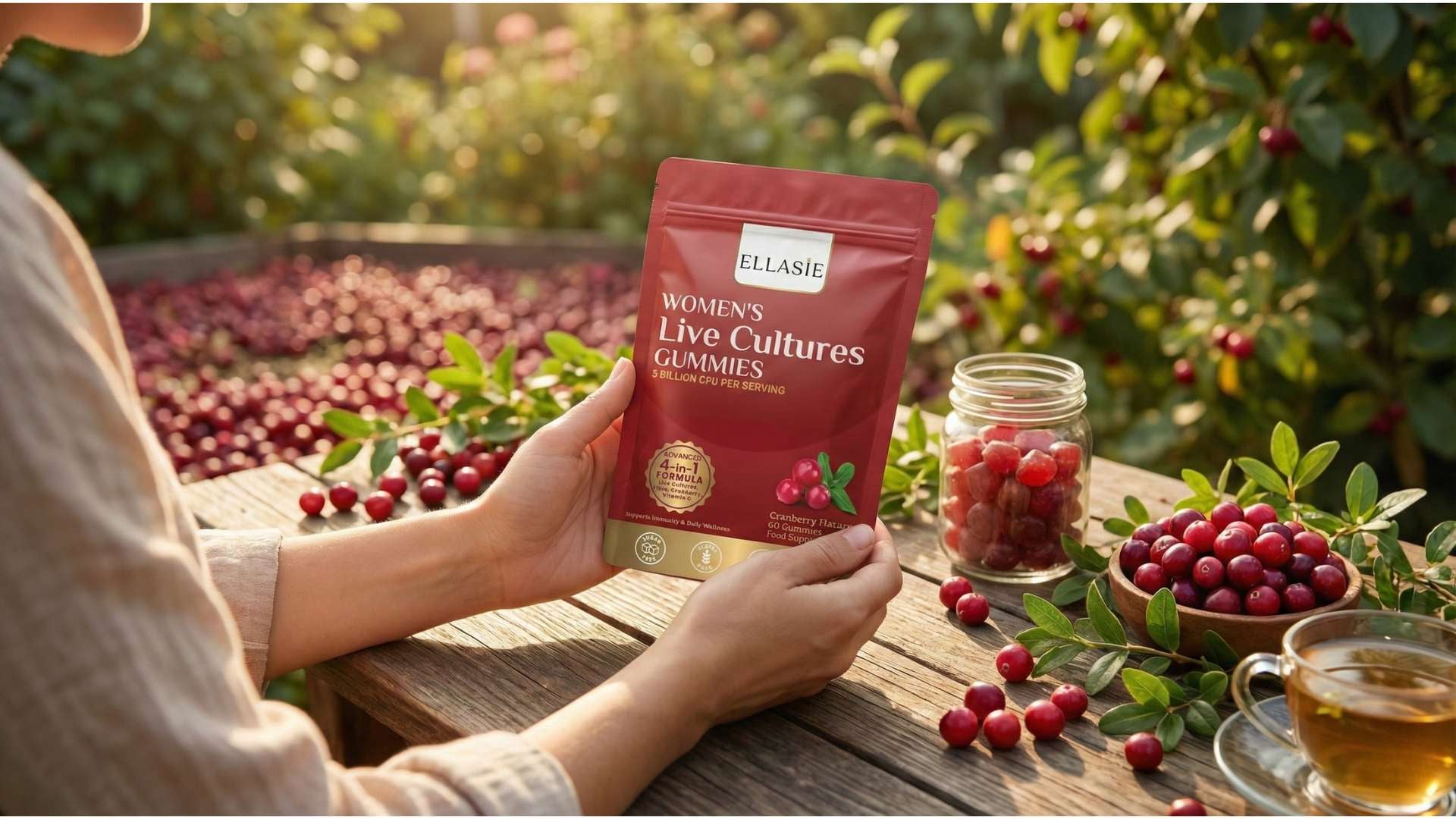
Medical note: Cranberry gummies are not a treatment for an active urinary tract infection (UTI). Burning when you pee, urgency, lower abdominal pain, blood in your urine, fever, shivering or pain in your back or side may need prompt assessment. This article is for general education and cannot diagnose the cause of urinary symptoms.
Key takeaways
- Cranberry products may reduce recurrent UTIs in some women. The best current review found a modest average reduction in symptomatic, culture-confirmed UTIs, but results vary.
- The evidence is about cranberry products broadly, not gummies specifically. A pleasant format does not compensate for an unclear or very small cranberry dose.
- There is no universally established cranberry-gummy dose. PAC content may be more informative than a large “cranberry extract” number, but even the often-quoted 36 mg PAC target is not a formal clinical standard.
- Cranberry cannot clear an infection that has already started. Do not wait for a supplement to work when you have active or worsening symptoms.
- Safety still matters. Avoid cranberry products if you take warfarin unless your anticoagulation clinician has specifically advised otherwise, and ask for medical advice if you are pregnant or have recurrent symptoms.
Do cranberry gummies help prevent recurrent UTIs?
Possibly, for some women, but the answer is more limited than many supplement labels suggest. Research on cranberry products shows a modest reduction in recurrent symptomatic UTIs in certain groups, particularly women who already experience repeated infections. Cranberry does not guarantee prevention, and it does not relieve or treat an infection that is already active.
There is another important limitation: the strongest review evidence combines cranberry juice, tablets, capsules and other preparations. It does not prove that every cranberry gummy delivers the same result. A gummy only becomes a plausible version of the studied intervention when its daily serving provides a transparent, meaningful cranberry preparation and is taken consistently.
This distinction is central to Ellasie’s Women’s Wellness Science Library: an ingredient can have encouraging evidence while a particular format, dose or finished product still needs separate scrutiny. “Contains cranberry” is not the same as “matches a studied cranberry preparation”.
If you are comparing cranberry with probiotics, read how cranberry and probiotics differ for urinary health.
The short version: cranberry gummies may be a reasonable prevention option for a non-pregnant adult woman with genuinely recurrent UTIs, provided expectations are realistic and the label is transparent. They are the wrong tool for treating current symptoms.
What counts as a recurrent UTI?
The NHS defines recurrent UTIs as two infections within six months or three within twelve months. The European Association of Urology uses the same practical threshold for recurrent cystitis.
That definition matters because research on recurrence is not the same as research on an occasional episode of burning or urgency. Ideally, repeated infections should be assessed rather than self-labelled. A clinician may consider symptoms, urine testing, previous treatment, pregnancy, menopause, medicines and factors that affect bladder emptying. The aim is not to make every person undergo extensive testing; it is to confirm that the problem being prevented is actually recurrent UTI.
If you have never had the symptoms assessed, or tests repeatedly fail to show an infection, cranberry may be targeting the wrong problem. Vaginal irritation, hormonal dryness, sexually transmitted infections, pelvic-floor problems, bladder pain conditions and other causes can overlap with urinary symptoms.
What the evidence actually shows
The most useful overall source is the 2023 Cochrane review of cranberry for UTI prevention. It included 50 randomised or quasi-randomised trials involving 8,857 people.
For women with recurrent UTIs, eight trials with 1,555 participants suggested that cranberry products probably reduced symptomatic, culture-verified infections. The pooled risk ratio was 0.74, which represents an average relative reduction of about 26% compared with placebo, water or no specific treatment. It does not mean that every woman’s personal risk falls by exactly 26%, and it does not mean that cranberry prevents all recurrences.
| Question | Best-supported answer | Important limitation |
|---|---|---|
| Can cranberry reduce recurrent UTIs in women? | Probably for some women, with a modest average reduction in symptomatic, culture-confirmed infections. | Products, doses and study populations varied, so individual results are uncertain. |
| Are cranberry gummies specifically proven? | No strong gummy-specific conclusion can be drawn from the main review. | Most evidence is grouped across juice, tablets, capsules and other preparations. |
| Is one form clearly best? | No. | The review found very-low-certainty evidence when comparing juice with tablets or different PAC doses. |
| Can cranberry treat an active UTI? | No evidence supports using it to ease or treat an infection that has already started. | Active symptoms require the appropriate pharmacy or medical assessment. |
The review did not show the same benefit in every population. It found little or no evidence of benefit in pregnant women, elderly people living in institutions, or adults with neuromuscular bladder dysfunction and incomplete bladder emptying. This does not prove that cranberry can never help anyone in those groups; it means the positive finding in women with recurrent uncomplicated infections should not be casually applied to everyone.
It is also possible for two evidence summaries to sound different without one being dishonest. Trials used different cranberry sources, PAC measurements, daily doses, durations, definitions of UTI and levels of adherence. The current European Association of Urology guideline therefore describes cranberry evidence as mixed and says the appropriate dose and duration remain unclear.
How cranberry may work
Cranberry is not thought to work like an antibiotic. Its best-known compounds include A-type proanthocyanidins, usually shortened to PACs. Laboratory evidence suggests these compounds and their metabolites may make it harder for some UTI-causing bacteria, particularly certain Escherichia coli, to attach to cells lining the urinary tract.
This is an anti-adhesion theory, not a claim that cranberry “kills bacteria”, sterilises the bladder or clears an established infection. Once symptoms have started, delaying appropriate care while relying on cranberry can allow a more serious infection to develop.
The proposed mechanism also helps explain why cranberry is studied as a repeated preventive routine rather than an occasional rescue gummy. Taking it only after burning begins is not how prevention evidence should be interpreted.
Dose: cranberry extract, PACs and the 36 mg question
There is no universally established daily dose for cranberry gummies. Cochrane found no established PAC regimen and very-low-certainty evidence for differences between PAC doses. The current European guideline likewise says the appropriate clinical dose and treatment duration are unclear.
You will often see 36 mg of PACs per day presented as the answer. That figure is not invented, but it is frequently oversold. A 2024 systematic review and meta-analysis of ten trials found a preventive signal when average intake reached at least 36 mg PACs daily, with a stronger signal in studies lasting 12 to 24 weeks. However, the authors noted limited sample sizes, variable trial quality and differences in how PACs were measured. The earlier, larger Cochrane review did not establish a clear dose-response relationship.
The sensible conclusion is that 36 mg PACs can be a useful transparency marker, not an official prescription and not proof that a gummy works. A label should also state whether the PAC amount applies to one gummy or the full daily serving and, ideally, how it was measured. Different analytical methods can produce numbers that are not directly comparable.
Total cranberry milligrams are not PAC milligrams
A front label may advertise 500 mg, 5,000 mg or an even larger “cranberry equivalent”. That number may describe whole-fruit powder, an extract, a concentrated equivalent or a blend. It does not tell you how many milligrams of PACs the serving provides.
An extraction ratio can be useful manufacturing information, but multiplying the extract weight by that ratio does not create a clinically validated dose. If two labels use different ingredients and measurement methods, the larger number is not automatically the stronger or better option.
How to assess a cranberry-gummy label
Use the full daily serving, not the marketing headline, when comparing products.
| Label item | What to check | Why it matters |
|---|---|---|
| Serving size | How many gummies make one daily serving? | A benefit number on the front may apply to two, four or more gummies rather than one. |
| Cranberry ingredient | Is it whole-fruit powder, juice concentrate or a standardised extract? | Different ingredients cannot be compared by weight alone. |
| PAC content | Is the daily PAC amount stated, and does the brand explain the test method? | PAC transparency makes the label more comparable with the prevention literature. |
| “Equivalent to” claim | Is the true extract weight shown as well as the raw-fruit equivalent? | A dramatic equivalent number can hide a small amount of actual extract. |
| Sugars and sweeteners | Check sugar and carbohydrate per full serving, plus any sweeteners that upset your digestion. | The NHS notes that cranberry products can contain a lot of sugar; gummies vary widely. |
| Other active ingredients | List every added vitamin, herb or culture and check whether each has a clear amount. | A longer blend is not automatically more effective and can add interactions or duplication. |
| Cautions and allergens | Check medicine warnings, pregnancy advice and allergen information. | A convenient format does not remove normal supplement safety checks. |
A weak label: “cranberry blend 1,000 mg” with no ingredient form, no PAC amount and no explanation of whether the number applies per gummy or per daily serving.
A more useful label: the actual cranberry ingredient and amount per daily serving, transparent PAC information where claimed, complete sugar and allergen details, clear directions and appropriate safety warnings.
Gummies versus juice, tablets and capsules
No format has been proved universally superior. The choice is a trade-off between formulation transparency, daily intake and practicality.
- Gummies can be easier to remember and take, but their ingredient capacity is limited and they may contain sugar or sugar alcohols. Some do not disclose PAC content.
- Capsules and tablets can hold more concentrated extracts and may provide clearer standardisation, but only if the label actually supplies that information.
- Juice contributes fluid and was included in cranberry research, but PAC content and sugar vary. It may also irritate the bladder for some people who already have symptoms.
The best format is not simply the one you prefer taking. It is the one that combines a plausible formulation, a safe serving, transparent labelling and a routine you can realistically follow. Convenience matters only after those basics are met.
Who may benefit, and who should be cautious
A reasonable person to discuss cranberry with
A non-pregnant adult woman with two UTIs in six months or three in twelve months, whose episodes have been appropriately assessed, is closest to the group with supportive evidence. Cranberry can be discussed as one preventive option, not as a replacement for diagnosis or other clinically appropriate strategies.
People who need more individual advice
- Anyone with active symptoms: use the appropriate pharmacy or medical pathway rather than starting a “wait and see” gummy trial.
- Pregnant people: suspected UTI requires prompt assessment, and the Cochrane review did not show preventive benefit from cranberry in pregnancy.
- People taking warfarin: the NHS advises avoiding cranberry products because of the potential interaction.
- People with diabetes: compare total sugar and carbohydrate per daily serving and ask for individual advice where needed.
- People with kidney disease, a history of urinary stones or fluid restrictions: discuss both the supplement and any hydration changes with the clinician managing the condition.
- People with difficulty emptying the bladder, a catheter, urinary-tract abnormalities or a weakened immune system: evidence from otherwise healthy women should or not be applied without clinical guidance.
Commonly reported cranberry side effects are digestive, such as stomach discomfort. Stop and seek advice if you develop a suspected allergic reaction or another concerning symptom. If you use prescribed medicines, check the complete gummy formula with a pharmacist rather than assessing cranberry in isolation. The NHS warfarin guidance also advises discussing any new supplement with the clinician managing warfarin.
Using cranberry as part of a prevention plan
Cranberry should sit inside a plan that starts with the right diagnosis. If you and a healthcare professional decide that a trial is reasonable:
- Choose one transparent product. Record the daily serving, cranberry ingredient, PAC information and sugar rather than switching between unrelated formulas.
- Use it preventively and consistently. Follow the label. Do not double the serving when symptoms appear.
- Track meaningful outcomes. Record clinician- or pharmacy-assessed UTI episodes, relevant urine results and antibiotic courses, not vague day-to-day sensations alone.
- Agree when to review. There is no official gummy trial length. Emerging research has examined consistent use over several months, but continuing indefinitely without benefit or review is not evidence-led.
- Keep other prevention options on the table. Cranberry is one choice, not the whole recurrent-UTI pathway.
Hydration advice should also be personal rather than competitive. In a randomised trial of 140 premenopausal women with recurrent cystitis who drank less than 1.5 litres of fluid daily, adding 1.5 litres of water each day reduced recurrences over twelve months. That result applies most directly to low-fluid drinkers without a reason to restrict fluids. If you have heart or kidney problems, ask how much is suitable for you.
The NHS also recommends practical measures such as not holding urine, trying to empty the bladder fully, wiping from front to back, avoiding scented products around the genital area and urinating soon after sex. For people in perimenopause or after menopause, a GP may discuss vaginal oestrogen as a recurrent-UTI prevention option. These measures are not proof that a UTI is caused by poor hygiene, and recurrence is not a personal failure.
When urinary discomfort may not be a UTI
Burning, soreness and urinary frequency do not always have the same cause. Vaginal inflammation or discharge changes can cause pain when urine touches irritated tissue. Ellasie’s guide to what vaginal discharge can mean explains which changes may point away from a straightforward bladder infection.
Hormonal dryness can also cause soreness, itching, discomfort during sex, urinary frequency and repeated urinary symptoms. The NHS notes this overlap in its vaginal-dryness guidance, while Ellasie’s practical article covers the causes of vaginal dryness and itching.
This does not mean you should diagnose yourself from a symptom list. It means repeated negative tests, unusual discharge, external irritation, pain during sex or symptoms that do not respond as expected deserve a broader assessment instead of a stronger cranberry product.
When to seek medical help
Follow the current NHS UTI advice and seek urgent clinical help if symptoms worsen quickly or do not improve within 48 hours of starting treatment or self-care, or if you have:
- a very high or low temperature, shivering or feeling seriously unwell;
- pain in your lower abdomen, back or side under the ribs;
- blood in your urine;
- pregnancy, diabetes, a catheter or a weakened immune system;
- recurrent UTIs meeting the two-in-six-months or three-in-twelve-months threshold; or
- persistent symptoms after treatment or repeated symptoms with unclear test results.
Do not use cranberry gummies to delay assessment. Fever, shivering, sickness, pain in the back or side, marked weakness, confusion or rapidly worsening symptoms can indicate a more serious infection. Seek urgent medical care.
Ellasie’s medical review policy explains how health articles are checked and why general evidence cannot replace an assessment based on your symptoms, test results, medicines and medical history.
The bottom line
Cranberry products probably reduce recurrent symptomatic UTIs for some women, but the average benefit is modest and the evidence is not specific to every gummy on the market. No universal gummy dose has been established. PAC disclosure can improve label transparency, yet the popular 36 mg figure is an emerging research marker rather than a guaranteed or officially prescribed dose.
If you choose cranberry, assess the complete daily serving, use it as prevention rather than treatment, check sugar and medicine cautions, and review whether it is actually reducing properly assessed episodes. The best outcome is not owning the strongest-sounding gummy. It is having fewer infections without missing a diagnosis or delaying care.
Frequently asked questions
How many cranberry gummies should I take each day?
There is no universal evidence-based number of gummies. Follow the product’s labelled daily serving and assess what that full serving provides. One brand may deliver its stated cranberry amount in one gummy, while another may require several. Do not exceed the directions to chase a larger dose.
Is 36 mg of PACs the proven dose for recurrent UTIs?
No. A 2024 meta-analysis found a preventive signal at 36 mg PACs or more per day, but trial quality, formulations and measurement methods varied. Cochrane did not establish a clear dose-response relationship. Treat 36 mg as a useful label-comparison marker, not a guaranteed or universally recommended dose.
Can I take cranberry gummies only when UTI symptoms start?
That is not how the prevention evidence should be used. Cranberry does not treat an active UTI. If symptoms start, follow the appropriate pharmacy or medical advice rather than taking extra gummies or waiting for them to work.
Can I take cranberry gummies with antibiotics?
Cranberry is not a substitute for prescribed antibiotics. A simple cranberry-only product may be compatible for many people, but multi-ingredient gummies and individual medicines differ. Ask a pharmacist or prescriber to check the complete label, and take antibiotics exactly as directed.
Are sugar-free cranberry gummies automatically better?
No. Lower sugar may suit some people, but it does not prove the cranberry dose is meaningful or effective. Sugar-free gummies may use polyols or other sweeteners that can cause digestive symptoms. Compare the cranberry ingredient, PAC transparency, full serving, total formula and safety information.
Should I use cranberry gummies during pregnancy or while taking warfarin?
Do not self-manage suspected UTI during pregnancy; seek prompt clinical advice and ask before taking a cranberry supplement. If you take warfarin, the NHS advises avoiding cranberry products unless the clinician managing your anticoagulation has specifically told you otherwise.
References and further reading
- NHS: Urinary tract infections
- Cochrane: Cranberries for preventing urinary tract infections
- European Association of Urology: Urological infections guideline
- Frontiers in Nutrition: PAC dose and cranberry UTI-prevention meta-analysis
- JAMA Internal Medicine: Increased daily water intake and recurrent cystitis trial
- NHS: Warfarin
- NHS: Vaginal dryness