



Key takeaways
- Probiotics are live microorganisms that provide a demonstrated health benefit when used in an adequate amount.
- Prebiotics are substrates selectively used by host microorganisms in a way that provides a health benefit. They are often types of fermentable carbohydrate, but not every fibre is automatically a prebiotic.
- Neither is universally “better”. A probiotic is a strain-specific option; prebiotic foods and fibres work through microorganisms already present.
- A product containing both may be called a synbiotic, but simply combining bacteria and fibre does not prove that the finished formula works better.
- Definitions do not prove benefits. The exact strain or substrate, dose, formulation, population and intended outcome all matter.
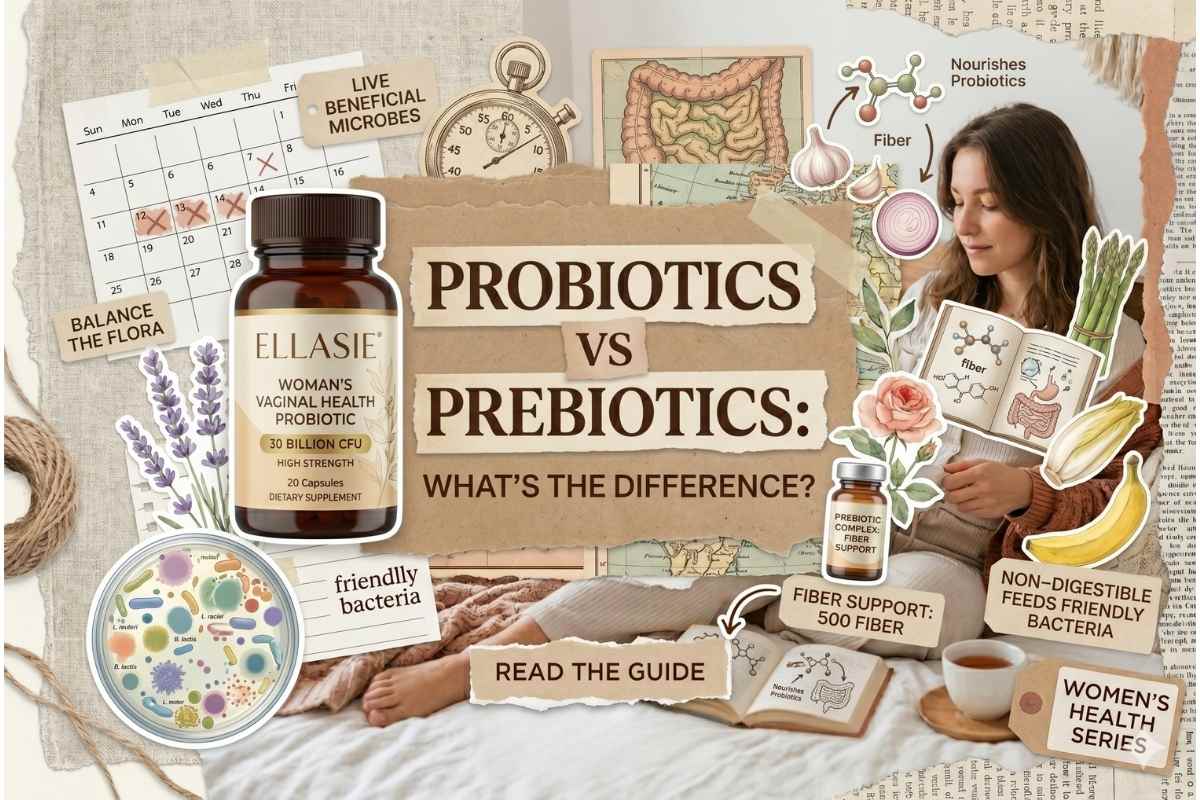
Probiotics and prebiotics are not the same thing. Probiotics are specific live microorganisms supplied through a food or product. Prebiotics are substances used by selected microorganisms already living in or on the body. Put simply, probiotics provide live microbes; prebiotics provide a usable substrate. That shorthand is helpful, but the scientific definitions are stricter than “good bacteria” and “food for good bacteria”.
The difference matters because labels often blur the two. A large colony-forming unit (CFU) number does not make a product a prebiotic. A fibre ingredient does not prove that a product is a probiotic. A supplement that contains both is not automatically more effective than either component alone. Each claim needs evidence relevant to the exact ingredient, amount, formulation and purpose.
This article compares the two categories and helps you decide what to look for. For the wider foundation on strains, CFU, storage and product evidence, read Ellasie’s probiotic evidence and label guide.
Probiotics vs prebiotics at a glance
| Question | Probiotics | Prebiotics |
|---|---|---|
| What are they? | Live microorganisms administered in an adequate amount with a demonstrated health benefit. | Substrates selectively used by host microorganisms that confer a health benefit. |
| Do they contain live microbes? | Yes. Viability is part of the definition. | No. They are substrates used by microorganisms. |
| Common examples | Defined bacterial or yeast strains used in researched foods or supplements. | Inulin, fructo-oligosaccharides (FOS), galacto-oligosaccharides (GOS) and certain other substrates with appropriate evidence. |
| What needs to match the evidence? | Strain or strain combination, amount, formulation, population and outcome. | Specific substrate, amount, selective use by microorganisms, population and outcome. |
| Typical label clues | Full strain names, viable count, serving size, storage and expiry information. | Named substrate, amount per serving, serving instructions and tolerance guidance. |
| Common tolerance issue | Some people report temporary gas or changes in bowel habits. | Fermentable fibres can cause gas, bloating or changes in stools, especially when intake rises quickly. |
The shortest useful answer: a probiotic supplies a defined live microorganism; a prebiotic supplies a substrate that selected microorganisms can use. Both terms also require evidence of a health benefit, so neither word should be treated as a guarantee.
What are probiotics?
The widely used scientific definition describes probiotics as live microorganisms that, when administered in adequate amounts, confer a health benefit on the host. The definition has several parts. The microorganisms must be alive, identified appropriately, supplied in a sufficient amount and connected to evidence of benefit.
This is narrower than the way “probiotic” is used in advertising. A food can contain living cultures without those cultures having been tested for a defined benefit. A supplement can list several bacterial species without identifying the strains. Neither situation proves that the product matches a clinical study.
Strain identity matters
Probiotic evidence can be strain-specific. Genus and species names identify only part of the organism. An additional letter-and-number code may identify the strain used in research. Two strains within the same species can differ in survival, activity and studied outcomes, so findings for one should not automatically be assigned to the other.
The same principle applies to combinations. Evidence for a blend belongs to that blend at the studied dose and in the studied population. A longer ingredient list or higher headline CFU figure is not automatically better.
Probiotics do not necessarily become permanent residents
Many supplemental microorganisms are transient. They may pass through the gastrointestinal tract and interact with the existing microbiota or host without permanently colonising the gut. A temporary presence does not mean they cannot have an effect, but “repopulate your gut forever” is not a responsible general promise.
Where probiotics can appear
Probiotics may be delivered in certain yoghurts or fermented milk products, capsules, powders, liquids and gummies. Format affects convenience, manufacturing and storage, but format alone does not establish effectiveness. A gummy is not inherently weaker than a capsule, and a capsule is not automatically evidence-based because it looks clinical.
What are prebiotics?
The consensus definition describes a prebiotic as a substrate that is selectively utilised by host microorganisms and confers a health benefit. Most familiar examples are types of carbohydrate, although the definition is not restricted to dietary fibre or to the gut.
In everyday nutrition, prebiotics are often described as food for beneficial gut bacteria. This captures the basic idea: the substrate resists digestion or absorption earlier in the digestive tract, reaches microorganisms that can use it and changes microbial activity or composition. The scientific standard goes further by requiring both selective utilisation and a demonstrated health benefit.
Not every fibre is a prebiotic
Fibre is valuable for health, but “fibre” and “prebiotic” are not interchangeable labels. Dietary fibres differ in solubility, viscosity and fermentability. To call a specific substance a prebiotic responsibly, evidence should show that host microorganisms use it selectively and that this is associated with a health benefit in the target population.
Commonly discussed prebiotic ingredients include inulin, FOS and GOS. Some forms of resistant starch and other substrates are also investigated, but the evidence belongs to the specific material and use. A product should name its ingredient rather than relying only on the word “prebiotic”.
Food sources
Onions, garlic, leeks, asparagus, artichokes, chicory root and bananas are commonly cited as sources of prebiotic carbohydrates. Oats, barley, legumes, wholegrains, nuts, seeds, fruit and vegetables contribute different forms of fibre to a varied diet. Not every food needs a “prebiotic” label to be worthwhile.
For many people, broadening the variety of fibre-rich foods is a more useful first step than looking for a single fashionable ingredient. People with irritable bowel syndrome, inflammatory bowel disease, a prescribed low-fibre diet or other digestive conditions may need individual advice because rapidly increasing fermentable fibre can worsen symptoms.
How do probiotics and prebiotics work differently?
A probiotic begins with the microorganism supplied. Researchers ask whether that strain or combination survives the product and route of administration, reaches the relevant site in a viable state, and produces a meaningful outcome at the studied amount.
A prebiotic begins with the substrate. Researchers ask whether host microorganisms use it selectively, how microbial composition or function changes, and whether the same study demonstrates a relevant health benefit. The mechanism is therefore built into the definition of a prebiotic in a way that it is not for a probiotic.
Both categories are more specific than general “microbiome support”. A probiotic tested for one digestive outcome should not be assumed to improve intimate health, mood or immunity. A prebiotic shown to affect one bacterial group or outcome should not be presented as a universal gut reset.
The body site also matters. The gut and vagina are distinct ecosystems. Oral probiotics, vaginal products and dietary prebiotics use different routes and may be studied for different outcomes. If you are comparing products marketed for intimate wellness, first understand what vaginal probiotics are and why evidence from a gut product cannot simply be transferred to them.
What are synbiotics?
A synbiotic is a mixture containing live microorganisms and substrate or substrates selectively used by host microorganisms that confers a health benefit. It brings probiotic and prebiotic concepts into one formulation, but it does not mean that any probiotic-plus-fibre combination qualifies automatically.
Consensus guidance distinguishes two broad approaches:
- Complementary synbiotics combine a probiotic and prebiotic, with each component meeting its respective evidence requirements.
- Synergistic synbiotics are designed so the substrate is selectively used by the co-administered microorganism, with evidence for the combined benefit.
“Contains probiotics and prebiotics” is therefore a description of ingredients, not proof of synergy. The finished combination still needs a rational amount, appropriate stability and evidence relevant to its intended use.
Probiotic or prebiotic: which should you choose?
Neither is automatically better. The sensible choice depends on the problem you are trying to solve, what evidence exists and whether you need a supplement at all.
| Situation | What to consider first | Why |
|---|---|---|
| You want general dietary support | Build variety across vegetables, fruit, wholegrains, beans, pulses, nuts and seeds. | This improves overall fibre intake without assuming one supplement is necessary. |
| You have a specific goal with strain-level evidence | Compare the researched strain, amount, formulation and duration with the label. | Probiotic effects cannot be generalised across every organism or product. |
| Your diet is low in fermentable fibre | Increase suitable foods gradually, or seek dietetic advice if symptoms limit your choices. | Prebiotic supplements are not a substitute for an inadequate or poorly tolerated diet. |
| You are considering a synbiotic | Check the evidence for the complete combination, not only the separate ingredients. | A combined formula is not automatically synergistic or superior. |
| You have persistent or unexplained symptoms | Seek professional assessment before self-treating with supplements. | Bloating, diarrhoea, constipation, pain or intimate symptoms can have several causes. |
A useful decision starts with the outcome, not the trend. Ask what you want to change, whether a qualified professional should assess the symptom, and whether human evidence exists for the exact ingredient and person. If those questions cannot be answered, the marketing may be more specific than the evidence.
Food versus supplements
Fermented foods are not all proven probiotics
Live yoghurt and some fermented foods may contain microorganisms, but the presence of live cultures alone does not meet the scientific probiotic definition. The organisms, amount and demonstrated benefit still matter. Heat processing, storage and the natural variability of food production can also affect how many live microorganisms remain.
That does not make fermented foods pointless. They can add variety, flavour and nutrients to a balanced diet. It simply means “fermented”, “contains live cultures” and “clinically studied probiotic” are not interchangeable claims.
Prebiotic foods offer more than one isolated substrate
Vegetables, fruit, wholegrains and pulses provide mixtures of fibre, vitamins, minerals and plant compounds. A prebiotic supplement can deliver a defined substrate and amount, but it should complement rather than replace dietary variety unless a healthcare professional recommends otherwise.
Supplements can be more defined, but not automatically better
A supplement may make it easier to state a strain, CFU amount or prebiotic dose. That precision is useful only when the label is transparent, the stated amount remains viable where relevant, and evidence matches the intended use. Supplements are generally regulated as foods rather than medicines in the UK, so consumers should not assume medicine-level testing or proof.
How to compare probiotic, prebiotic and synbiotic labels
For a probiotic
- Look for full organism identification. Genus and species are helpful; a strain designation is essential when strain-specific research is being used.
- Read the amount in context. A higher CFU count is not necessarily better. It should match evidence for the organism and outcome.
- Check when the count applies. “At manufacture” is different from a count guaranteed through the end of shelf life.
- Follow storage instructions. Temperature and moisture can affect viability in some products.
- Check the serving size. The front label may not show how many capsules, sachets or gummies supply the stated amount.
- Reject treatment promises. A food supplement should not claim to cure, prevent or treat disease.
Format is a separate decision from evidence. If you prefer chewables, use the same strain, serving, viability and ingredient checks when learning how to compare women’s probiotic gummies.
For a prebiotic
- Identify the substrate. “Prebiotic blend” without ingredient-level clarity is difficult to compare with research.
- Find the amount per daily serving. Evidence and tolerance depend on dose, not merely the presence of the ingredient.
- Consider your existing fibre intake. Adding a concentrated fermentable substrate to an already sensitive gut may increase discomfort.
- Separate fibre claims from prebiotic evidence. A fibre can be nutritionally useful without meeting every criterion for a prebiotic.
For a synbiotic
- Check the probiotic strain or strains and viable amount.
- Check the prebiotic substrate and amount.
- Look for evidence relevant to the complete formulation and intended outcome.
- Do not assume “two-in-one” means stronger, faster or more suitable.
Transparent formulation principles are explained on how Ellasie chooses ingredients. The same checklist should be applied critically to any brand.
Safety and tolerance
Prebiotic fibres can increase gas and bloating
Because gut microorganisms ferment many prebiotic substrates, gas, bloating, abdominal discomfort or stool changes can occur, particularly when intake rises quickly. Starting with a smaller amount and increasing gradually may improve tolerance, but follow the product directions rather than inventing a dose.
People with IBS can be sensitive to fermentable carbohydrates, while some people with bowel disease, narrowing of the gut or a medically prescribed diet may need specific fibre advice. A registered dietitian or clinician can help distinguish a useful gradual increase from an ingredient that does not suit you.
Live microorganisms need extra caution in higher-risk groups
Probiotics appear to be well tolerated by many healthy people, but risk is not identical for every organism or person. Obtain professional advice before using a probiotic if you are severely immunocompromised, critically ill, receiving cancer treatment, living with a central venous catheter or another complex medical device, or managing a serious underlying condition.
Also ask a healthcare professional before giving a supplement to a baby or child, or when pregnant, breastfeeding, taking medicines, preparing for surgery or using a prescribed restricted diet. Check allergen statements and other ingredients, including milk, soy, yeast, sweeteners and capsule materials.
What the evidence can and cannot tell you
Consensus definitions make language clearer; they do not prove that every product works. “Probiotic”, “prebiotic” and “synbiotic” should each connect to a demonstrated benefit, but consumer labels and marketing may use the words more loosely.
When reviewing a study, ask whether it tested:
- the same microorganism or substrate;
- the same amount and formulation;
- the same route of administration;
- a population similar to the intended user;
- a meaningful health outcome rather than only a laboratory marker; and
- a duration relevant to the claim.
Microbiome changes alone are not always a clinical benefit. More of one bacterial group is not automatically better, and a shift in a laboratory measure does not necessarily mean someone feels or functions better. Reliable conclusions need appropriate human studies, transparent methods and outcomes that matter.
It is equally important not to turn uncertainty into a blanket dismissal. Some specific probiotics and prebiotics have useful evidence in defined contexts. The honest position sits between “all microbiome products work” and “none of them can help”. Product-specific evidence and individual suitability decide where they fit.
Bottom line
Probiotics are live microorganisms supplied in an adequate amount with a demonstrated health benefit. Prebiotics are substrates selectively used by host microorganisms that confer a health benefit. They act through different starting points, and neither category is automatically superior.
Start with the goal. For general nutrition, a varied fibre-rich diet is usually the foundation. For a targeted probiotic, match the strain, amount, formulation and evidence to the intended use. For a prebiotic, identify the substrate, dose and tolerance. For a synbiotic, look for a rational, evidence-led combination rather than assuming that two ingredients must be better than one.
Most importantly, do not use supplement labels to self-diagnose symptoms. Persistent digestive or intimate-health changes deserve the right assessment, not a more complicated shopping basket.
Frequently asked questions
Which is better for gut health: probiotics or prebiotics?
Neither is universally better. Prebiotic foods can support dietary fibre variety and microorganisms already in the gut. A probiotic may be relevant when a particular strain or combination has evidence for a specific goal. Your diet, symptoms, health history and the exact evidence matter more than the category name.
Can you take probiotics and prebiotics together?
They can be used together, either separately or in a synbiotic. That does not prove the combination is superior. Check the exact strains, substrate, amounts, evidence and directions, and introduce fermentable fibre cautiously if you are prone to bloating.
Is yoghurt a probiotic or a prebiotic?
Yoghurt with live cultures contains microorganisms, but it meets the scientific probiotic definition only when the organisms, amount and demonstrated health benefit satisfy the relevant criteria. Yoghurt is not normally described as a prebiotic unless it contains a qualifying prebiotic substrate.
Is every type of fibre a prebiotic?
No. Fibre is a broad nutritional category. A prebiotic must be selectively used by host microorganisms and confer a demonstrated health benefit. A fibre can still be valuable even when it has not been established as a prebiotic.
Do probiotic supplements permanently colonise the gut?
Many supplemental strains are transient and may no longer be detectable after use stops. They can still interact with the host or resident microbiota while being consumed, but permanent colonisation should not be promised as a general outcome.
Can prebiotics make bloating worse?
Yes. Fermentable substrates can increase gas, bloating, discomfort or stool changes, especially when the amount rises quickly. Follow product directions and seek individual advice if you have IBS, bowel disease, severe symptoms or a medically restricted diet.
References and further reading
- International Scientific Association for Probiotics and Prebiotics. Consensus statement on the scope and appropriate use of the term probiotic.
- International Scientific Association for Probiotics and Prebiotics. Criteria for classifying compounds as prebiotics. 2024.
- International Scientific Association for Probiotics and Prebiotics. Consensus statement on the definition and scope of synbiotics.
- NHS. Probiotics.
- British Dietetic Association. Probiotics and gut health.
- British Dietetic Association. Fibre.
- US National Institutes of Health, Office of Dietary Supplements. Probiotics: fact sheet for health professionals. Updated 25 March 2025.