



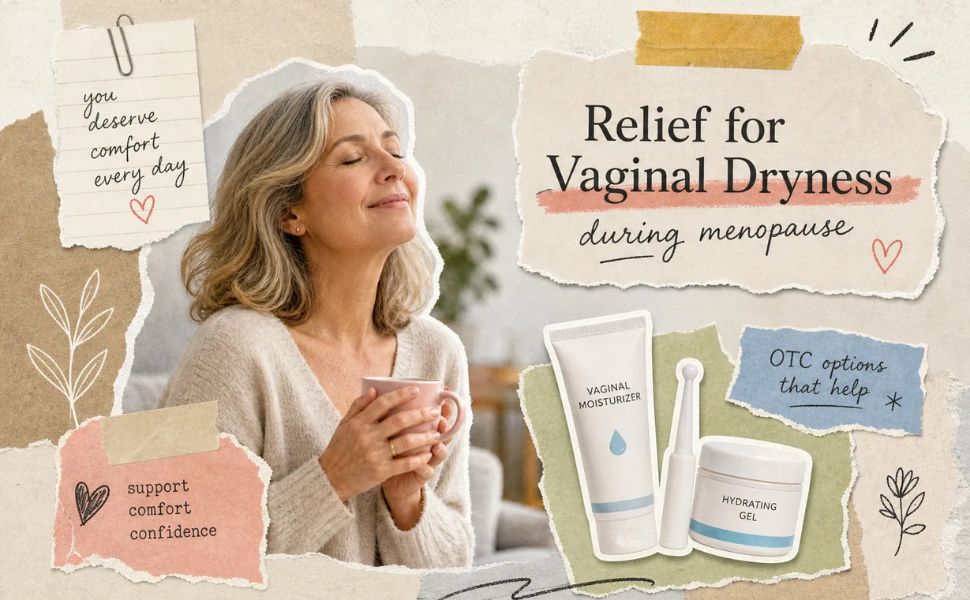
Medical note: Vaginal dryness around menopause is common, but dryness, burning, itching, pain, discharge and bleeding can have different causes. Any vaginal bleeding after menopause needs a GP assessment, even if it happens once or appears only as spotting or pink or brown discharge. Seek advice rather than repeatedly self-treating if symptoms are new, persistent, recurrent, severe or accompanied by unusual discharge, odour, sores, pelvic pain, fever or urinary symptoms.
Key takeaways
- A vaginal moisturiser and a lubricant are not the same product. A moisturiser is used regularly for ongoing dryness; a lubricant is used when friction needs to be reduced, usually before or during sexual activity.
- “Over the counter” covers different levels of access. Moisturisers and lubricants can usually be bought directly. One low-dose vaginal estradiol tablet is a Pharmacy medicine in the UK and is supplied only after a pharmacist checks that it is suitable.
- NICE recommends offering vaginal oestrogen for genitourinary symptoms associated with menopause. It can be used alone or with non-hormonal moisturisers or lubricants, but individual suitability and the exact product still matter.
- Choose by purpose, not by the biggest claim on the packet. Check whether the product is intended for internal vaginal use, external vulval use or lubrication, and follow its own directions.
- Supplements and probiotics are not established treatments for genitourinary syndrome of menopause. They should not replace moisturisers, lubricants, vaginal oestrogen or medical assessment.
OTC vaginal dryness treatments during menopause: the direct comparison
For ongoing vaginal dryness, compare purpose-made vaginal moisturisers. For friction during sex, compare lubricants. For symptoms caused by lower oestrogen that remain bothersome, discuss vaginal oestrogen with a pharmacist or clinician rather than treating it as an ordinary moisturiser.
These categories are often displayed together, but they do different jobs. A product that feels slippery is not automatically a long-acting moisturiser. A moisturiser that supports day-to-day comfort may not provide enough glide during sex. Vaginal oestrogen is a medicine that acts on oestrogen-depleted tissue; it is not simply a stronger lubricant.
| Option | Main role | How it is used | UK access | Main comparison point |
|---|---|---|---|---|
| Vaginal moisturiser | Ongoing dryness and day-to-day comfort | Regularly, according to the specific product | Usually available without a prescription | Intended site, formulation, directions and tolerability |
| Lubricant | Immediate friction reduction | Before or during sexual activity, as needed | Available without a prescription | Water, silicone or oil base; condom and toy compatibility |
| Low-dose vaginal estradiol tablet supplied by a pharmacist | Treatment of vaginal symptoms caused by postmenopausal oestrogen deficiency | As directed in the medicine leaflet and by the pharmacist | One specific product is a Pharmacy medicine for eligible users | Eligibility, contraindications, current symptoms and medical history |
| Other vaginal oestrogen formats and further GSM medicines | Clinically selected treatment when symptoms require it | According to the prescribed product | Prescription | Diagnosis, benefits, risks, preference and treatment response |
This guide uses UK access rules. Product classifications and brand availability differ in other countries. For the wider context—symptoms, stages, HRT and non-hormonal care—use Ellasie’s menopause symptoms and treatment guide.
Why vaginal dryness happens during menopause
Lower oestrogen during and after the menopause transition can affect the vulva, vagina, bladder and urethra. Vaginal tissue may become thinner, less elastic and less well lubricated. Symptoms can include dryness, burning, irritation, discomfort during sex, urinary urgency and recurrent urinary infections. The umbrella term genitourinary syndrome of menopause, or GSM, describes this group of genital, sexual and urinary changes.
Menopause can also be associated with a higher vaginal pH and changes in the organisms commonly present in the vagina. Those changes do not mean every symptom is a microbiome problem, and a pH product cannot confirm the cause. Ellasie’s vaginal microbiome and pH guide explains why flora, pH, symptoms and infection should not be treated as interchangeable ideas.
Dryness during midlife is not automatically GSM. Medicines, cancer treatment, skin conditions, irritation, infection, insufficient arousal, diabetes and Sjögren’s syndrome can produce overlapping symptoms. That is why an OTC comparison should begin with the symptom pattern, not with a promise printed on the front of a box.
Useful distinction: mild, recognisable dryness without warning signs may be reasonable to manage initially with a purpose-made moisturiser or lubricant. Unusual discharge, strong odour, marked itching, sores, pelvic pain, fever, bleeding or symptoms that keep returning need assessment rather than a more complicated shopping basket.
Vaginal moisturisers: what to compare
A vaginal moisturiser is intended to support hydration and comfort between applications. Unlike a lubricant, it is not limited to the moment of sexual activity. Products may come as gels, creams, ovules or pessary-like formats and may use ingredients such as hyaluronic acid or bioadhesive polymers to retain moisture.
Evidence suggests that vaginal moisturisers may improve dryness for some people in the short term, but the evidence is limited and products are not interchangeable. A 2024 systematic review found low-certainty evidence of benefit for moisturisers and noted that longer-term and head-to-head data remain limited. That makes “clinically proven category” or “best ingredient” claims too broad unless they refer to the exact tested formulation.
Use the directions for the exact product
Some moisturisers are used every few days; others have a different initial or maintenance schedule. There is no responsible universal instruction such as “use every product daily for two weeks, then twice weekly”. Apply only as directed, check whether the applicator is single-use or reusable, and do not insert an external vulval moisturiser unless the label specifically permits internal vaginal use.
Hyaluronic acid versus polycarbophil and other formulations
Hyaluronic acid attracts and retains water. Polycarbophil-based products are designed to adhere to the vaginal surface and retain moisture over time. Both approaches appear in non-hormonal products. Small studies and reviews are encouraging, but formulation, amount, application schedule and study quality vary. Texture, leakage, application method, irritation and willingness to use the product consistently may matter more in practice than choosing an ingredient from a “best of” list.
Vaginal and vulval products are not automatically interchangeable
The vagina is the internal canal; the vulva is the external genital area. Some products are intended for one, some for both. Ordinary body lotion, facial moisturiser, petroleum jelly, essential oil or food-based product should not be inserted into the vagina. The NHS specifically advises using products designed for vaginal dryness and avoiding perfumed washes and douches.
Water-, silicone- and oil-based lubricants
Lubricants reduce friction immediately. They can make sexual touch, penetration, an examination or use of a suitable device more comfortable, but they do not provide the same ongoing role as a vaginal moisturiser and do not treat oestrogen-related tissue change.
| Lubricant base | Potential advantage | Potential drawback | Compatibility check |
|---|---|---|---|
| Water-based | Easy to wash off; widely available; generally the simplest starting point | May dry or become sticky and need reapplication | Generally compatible with latex condoms and many toys, but check both labels |
| Silicone-based | Longer-lasting and less likely to dry quickly | Can be harder to wash away and may not suit every toy material | Often compatible with latex condoms; verify the lubricant, condom and toy instructions |
| Oil-based | Long-lasting slip for some users | Can stain, may be harder to remove and is not appropriate for every barrier method | Do not use with latex condoms because oil can damage the latex |
There is no single base that is best for everyone. Water-based is a practical default when broad compatibility and easy clean-up matter. Silicone-based may suit someone who needs longer-lasting glide. Oil-based formulas require particular caution with latex barriers. Whichever type you choose, stop if it causes burning, itching, swelling or worsening discomfort.
Fragrance, warming and “sensation” claims
For tissue that is already dry or sensitive, a simple unfragranced product is usually easier to evaluate than one containing flavour, perfume, warming, cooling or tingling ingredients. No single ingredient causes symptoms in everyone, so avoid absolute online rules such as “glycerin always causes thrush”. If a product repeatedly stings or symptoms follow its use, stop it and discuss the pattern with a pharmacist or clinician rather than trying to diagnose the ingredient yourself.
Pharmacy and prescription vaginal oestrogen
Vaginal oestrogen is local hormone replacement therapy. NICE recommends offering it to people with genitourinary symptoms associated with menopause and advises that it may be used alone or with non-hormonal moisturisers or lubricants. It is absorbed mainly locally, with a minimal amount reaching the bloodstream compared with systemic HRT.
It comes in several forms, including vaginal tablets, pessaries, creams, gels and rings. Most are prescription medicines. Vaginal oestrogen can improve local dryness and irritation, but it does not treat unrelated menopause symptoms such as hot flushes. Benefit can build over time; the NHS says it can take up to three months to work fully.
Is vaginal oestrogen available over the counter in the UK?
One specific low-dose estradiol vaginal tablet, Gina 10 micrograms, is classified as a Pharmacy medicine. It can be supplied without a prescription only after a pharmacist consultation and is licensed for vaginal atrophy caused by oestrogen deficiency in postmenopausal women aged 50 or over who have not had a period for at least one year.
That does not make every vaginal oestrogen product OTC, and it does not mean Gina is appropriate for everyone who meets the age and period criteria. The pharmacist must consider current symptoms, bleeding, infections, medical history, hormone treatment and contraindications. Do not use another person’s medicine or bypass the consultation by buying from an unregulated seller.
What if the pharmacy product is not suitable?
A GP or menopause clinician can assess the diagnosis and discuss other vaginal oestrogen formats, systemic HRT where relevant, and further treatments. NICE says vaginal prasterone may be considered when vaginal oestrogen or non-hormonal moisturisers or lubricants have been ineffective or are not tolerated; ospemifene may be considered in specific circumstances when locally applied treatments are impractical. These are prescription decisions, not products to add casually to an OTC routine.
What to compare on a vaginal dryness product label
- Intended purpose: Is it a regular vaginal moisturiser, an external vulval product, a lubricant or a medicine? Similar packaging does not mean the same use.
- Application site: Check whether it is intended for internal vaginal use, external vulval use or both. Do not infer this from the word “intimate”.
- Directions: Compare the full schedule, amount, applicator and maximum use. Follow the exact product rather than copying a routine from another brand.
- Ingredient simplicity: If tissue is sensitive, consider an unfragranced formula without warming, cooling or pleasure-enhancing additives.
- Condom and device compatibility: Look for explicit information about latex, non-latex barriers, applicators and sex toys. Never assume “natural” means compatible.
- pH and osmolality information: These technical properties may be useful when properly measured, but many consumer labels do not disclose them. Absence of a number does not allow you to calculate it from the ingredient list.
- Medicine status: If the product contains oestrogen or another active medicine, check whether a pharmacist or prescription is required and use the patient information leaflet.
- Warnings and expiry: Read contraindications, storage instructions, hygiene guidance and the use-by date, especially for multi-use applicators.
What do pH and osmolality actually tell you?
pH measures acidity. Osmolality measures the concentration of dissolved particles. Very hyperosmolar lubricants can draw water from cells in laboratory models, which is why WHO and UNFPA procurement specifications for plain water-based lubricants set an osmolality limit below 1,200 mOsm/kg.
That specification is useful context, but it is not a universal consumer ranking for every vaginal moisturiser, medicated gel or lubricant. The same WHO document describes procurement testing, composition, biocompatibility and condom compatibility—not just one number. Prefer a clearly labelled, purpose-made product from a reputable route and treat unsupported “pH-perfect” or “microbiome-safe” marketing as a claim to investigate, not proof.
Condom and sex-toy compatibility
If you use condoms, read the instructions on both products. The NHS advises not using oil-based lubricant with latex condoms; use a water- or silicone-based lubricant instead. Latex-free condoms may use different materials, so their own packet remains the authority.
Sex toys also vary. Silicone lubricant may affect some silicone toys, while other combinations may be permitted by the manufacturer. “Toy-safe” should identify which materials were considered. If either label is unclear, use a compatible water-based lubricant or ask the manufacturer rather than relying on a general internet rule.
A vaginal moisturiser can leave residue or discharge as it disperses. Check whether the product gives a waiting period before sex or recommends separate lubrication. If a condom breaks or comes off, contact a pharmacist, sexual health clinic, NHS 111 or a GP because emergency contraception or STI advice may be needed.
How moisturisers, lubricants and vaginal oestrogen can fit together
The choice is not always either/or. A moisturiser can address baseline dryness, while a lubricant reduces friction during sexual activity. NICE also states that vaginal oestrogen may be used with non-hormonal moisturisers or lubricants. The important part is knowing which symptom each product is intended to address and which directions apply.
- Define the main problem. Is the discomfort present day to day, mainly during sex, or accompanied by urinary symptoms, bleeding or discharge?
- Choose one appropriate starting category. For mild ongoing dryness without warning signs, that may be a purpose-made vaginal moisturiser. For friction only, it may be a lubricant.
- Introduce one new product at a time. This makes irritation, leakage and benefit easier to interpret.
- Use it exactly as directed. Do not double the amount because relief is not immediate and do not insert products intended only for external skin.
- Review the pattern. Note whether comfort, sex, urination or daily activity improves and whether any new burning, itching, discharge or bleeding appears.
- Escalate rather than endlessly switching. If symptoms persist for a few weeks, affect daily life or do not respond to self-care, speak to a GP, pharmacist or menopause clinician.
Do not push through painful sex. More friction can worsen irritation and pain can increase pelvic-floor muscle tension. Pause, add suitable lubrication and seek assessment if pain continues; dryness may not be the only cause.
Where supplements, probiotics and intimate washes fit
Oral supplements do not provide the immediate surface lubrication of a lubricant, the local hydration of a vaginal moisturiser or the established tissue effect of vaginal oestrogen. Research on individual botanicals or nutrients cannot be transferred automatically to a multi-ingredient retail product. A “moisture support” claim is not evidence that the finished supplement treats GSM.
Probiotic research is organism-, route- and outcome-specific. A product studied for bacterial vaginosis, digestive health or vaginal flora should not be presented as a treatment for oestrogen-related dryness. If you are considering one for a separate reason, Ellasie’s guide to who vaginal probiotics may suit covers life-stage and safety questions.
Intimate washes are not treatments either. The vagina is self-cleaning, and douching or perfumed products can worsen irritation. Use gentle, unperfumed external care and do not wash inside the vagina.
Breast-cancer history and hormone-sensitive conditions
For someone with a personal history of breast cancer, the choice should not be reduced to “all oestrogen is unsafe” or “local oestrogen is risk-free”. NICE recommends considering non-hormonal vaginal moisturisers or lubricants first. If symptoms persist, vaginal oestrogen may be considered after discussing recurrence risk, the amount absorbed into the bloodstream, treatment preferences and current cancer therapy.
If you are taking an aromatase inhibitor, involve a breast-cancer specialist before using vaginal oestrogen. The pharmacy product information for Gina also lists known, past or suspected oestrogen-dependent tumours among its contraindications, so it is not a route for bypassing specialist advice. Speak to your oncology team, breast-care nurse, GP or menopause clinician about the exact product.
The same individual approach applies with unexplained bleeding, previous endometrial cancer, blood clots, significant liver disease or other relevant medical history. A non-hormonal label is useful information, but it does not prove that a product will suit irritated tissue or explain the cause of symptoms.
When vaginal dryness needs medical assessment
Book a GP or appropriate clinic appointment
Arrange an assessment if dryness has lasted for a few weeks and self-care is not working, affects daily life, repeatedly returns or causes ongoing pain during sex. Also seek advice for unusual discharge, strong odour, pain when urinating, sores, lumps, skin colour or texture changes, symptoms after a new sexual partner, or concern about an STI. Ellasie’s separate guide explains possible causes of vaginal odour without treating odour as menopause by default.
Any bleeding after menopause needs checking
See a GP for any vaginal bleeding after you have gone 12 months without a period, even if it happens once, is only a small amount or looks like pink or brown discharge. Dry tissue can bleed, but that explanation should not be assumed before assessment.
Seek urgent advice for severe or systemic symptoms
Use NHS 111 or urgent medical care for rapidly worsening pelvic or lower-abdominal pain, fever or shivering, feeling significantly unwell, heavy bleeding, faintness or symptoms during pregnancy. Do not wait for a moisturiser, lubricant or supplement to work when warning signs are present.
Ellasie’s medical review policy explains why bleeding, cancer history, infection symptoms and medicine suitability require qualified review rather than product-led reassurance.
Bottom line
The best first comparison is functional: moisturiser for ongoing dryness, lubricant for friction and pharmacist or clinician-led vaginal oestrogen for eligible people who need treatment of oestrogen-related tissue symptoms. These options can be used together when appropriate, but each needs its own directions and compatibility checks.
Choose products made for the intended vaginal or vulval use, prefer simple formulations when tissue is sensitive, and check condoms, toys, medicines and applicators rather than relying on the word “natural”. Do not let an ingredient trend, pH claim or supplement promise distract from persistent symptoms.
Most importantly, do not normalise pain or bleeding. Vaginal dryness is common and treatable, but the right next step depends on the symptom pattern, medical history and whether self-care is actually helping.
Frequently asked questions
What is the best OTC treatment for vaginal dryness during menopause?
There is no single best product for every symptom. A purpose-made vaginal moisturiser is the main OTC category for ongoing dryness, while a lubricant is used for immediate friction reduction. Persistent or bothersome oestrogen-related symptoms may respond better to vaginal oestrogen, which requires a pharmacist or prescription route depending on the product.
What is the difference between a vaginal moisturiser and a lubricant?
A vaginal moisturiser is used regularly to support day-to-day hydration and comfort. A lubricant is used before or during sexual activity to reduce friction. Some people use both, but the products are not interchangeable.
Can I buy vaginal oestrogen without a prescription in the UK?
One specific estradiol 10 microgram vaginal tablet is a Pharmacy medicine for eligible postmenopausal women aged 50 or over who have not had a period for at least one year. A pharmacist must check suitability. Other vaginal oestrogen formats remain prescription medicines.
Can I use a vaginal moisturiser and lubricant together?
Yes, when their labels permit it. The moisturiser can be used on its regular schedule for baseline dryness and the lubricant separately when friction needs to be reduced. Check whether the moisturiser specifies a waiting period before sex.
Are “natural” oils safe as vaginal lubricants?
Natural does not guarantee that a product is suitable for vaginal tissue or compatible with contraception. Oil-based products can damage latex condoms. Use a purpose-made lubricant and follow the instructions for the lubricant, condom and any sex toy.
How long should I try an OTC product before speaking to a GP?
The NHS advises seeing a GP if dryness has lasted for a few weeks and self-care is not working or if it affects daily life. Do not wait for a trial period if you have bleeding, unusual discharge, sores, marked pain, fever, urinary symptoms or another warning sign.
References and further reading
- NHS: Vaginal dryness. Symptoms, causes, self-care and when to see a GP. Page last reviewed 24 July 2025.
- NICE: Menopause—identification and management, recommendations. NG23; genitourinary symptoms, vaginal oestrogen, non-hormonal options and breast-cancer considerations.
- NHS: Vaginal oestrogen. Uses, formats, suitability, directions and safety.
- MHRA: Pharmacy reclassification of Gina 10 microgram vaginal tablets. UK access criteria and pharmacist-supply requirements.
- Electronic Medicines Compendium: Gina 10 micrograms vaginal tablets—Summary of Product Characteristics. Licensed indication, directions, contraindications and warnings. Last updated 18 March 2025.
- Danan ER, Diem S, Sowerby C, et al. Hormonal treatments and vaginal moisturizers for genitourinary syndrome of menopause: a systematic review. Annals of Internal Medicine. 2024.
- WHO/UNFPA: Specifications for plain lubricants. Technical Report Series 1025, Annex 11.
- NHS: Condoms. Lubricant compatibility and action after condom failure.
- NHS: Postmenopausal bleeding. Why every episode, including spotting or pink or brown discharge, needs GP assessment.