



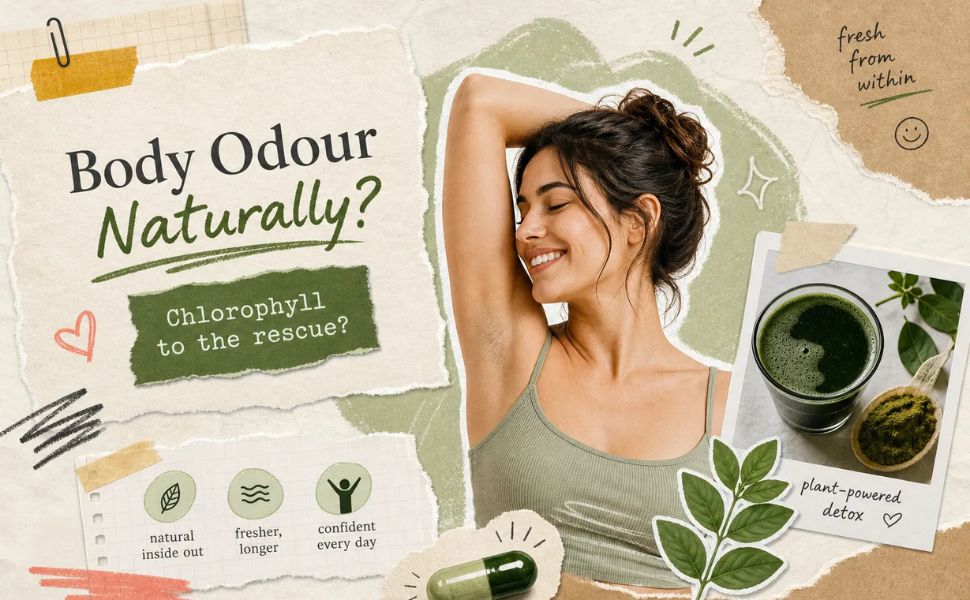
Medical note: A sudden, persistent or unusual change in body odour can have several causes. Chlorophyll supplements do not diagnose or treat the cause. Speak with a pharmacist or GP if self-care has not helped, the change is affecting your wellbeing, or you are sweating much more than usual.
Key takeaways
- There is not enough good evidence to say that oral chlorophyll or chlorophyllin reliably reduces everyday body odour.
- The best-known controlled trials studied urinary odour in catheterised older patients and faecal odour in people with colostomies—not ordinary underarm sweat in healthy adults.
- Neither controlled trial established a clear benefit over placebo. A later study found a promising laboratory change in three people with trimethylaminuria, but that rare condition is not the same as common sweat-related odour.
- Most supplements marketed as “chlorophyll” contain sodium copper chlorophyllin, a modified, water-soluble derivative. The form and amount on the label matter.
- Batch testing can support identity, purity or safety specifications. It cannot prove that a supplement reduces odour unless the finished product has been tested for that outcome in an appropriate human trial.
Does chlorophyll reduce body odour? The direct answer
It has not been shown to reduce ordinary body odour reliably. The human research is small, old and focused on medical situations that differ from everyday underarm, foot or groin odour. The two controlled crossover trials most often cited did not establish that chlorophyll or chlorophyllin performed better than placebo.
That is not the same as proving that no individual could ever notice a change. Odour varies with heat, activity, clothing, diet, hormones, skin microbes and expectation. A personal testimonial can be genuine while still being unable to show whether the supplement caused the improvement. To answer a product claim, researchers would need suitable participants, a placebo, blinding, a defined product and dose, objective or independently rated odour measures, and results that can be repeated.
This article stays with the narrow odour question. For the broader distinction between natural chlorophyll, chlorophyllin, other proposed uses and general safety, use Ellasie’s chlorophyll benefits and safety guide.
Evidence verdict: chlorophyllin has been investigated as an internal deodorant, but the available research does not justify promising that it will reduce everyday body odour in healthy adults.
Chlorophyll and chlorophyllin are not interchangeable
Chlorophyll is the family of green pigments plants use in photosynthesis. It is naturally present in foods such as spinach, parsley and other green vegetables. Sodium copper chlorophyllin is a manufactured, water-soluble mixture derived from chlorophyll. It is more stable in supplements and is often listed as sodium copper chlorophyllin, copper chlorophyllin or chlorophyllin copper complex.
This distinction matters because most of the human odour research used chlorophyllin tablets. Eating green vegetables, drinking a product labelled “liquid chlorophyll” and taking a capsule containing sodium copper chlorophyllin are not scientifically identical exposures. Evidence for one form, route, amount and population cannot simply be transferred to all of the others.
Front-of-pack language can blur the difference. A bottle may say “chlorophyll” in large type while the ingredient panel identifies chlorophyllin. Check the exact active name and the amount per daily serving. A large bottle-total figure is not the daily amount, and a green colour does not confirm the product’s identity or effectiveness.
Why the type and source of odour matter
“Body odour” is an umbrella phrase, not one outcome. Underarm odour, foot odour, breath, urine, faecal or ostomy odour, vaginal odour and the fish-like odour of trimethylaminuria can arise through different processes. A result in one category cannot be assumed to apply to another.
Common underarm odour is strongly influenced by skin microbes. Secretions reaching the skin can contain largely non-odorous precursors; bacteria transform some of them into volatile compounds that have a recognisable smell. This is why washing, drying, clothing choices, deodorants and antiperspirants act close to the source of ordinary sweat-related odour.
Internal compounds can sometimes affect breath, sweat or urine. Garlic, alcohol, medicines, metabolic disorders and health conditions provide real examples. But that does not prove the broad claim that normal body odour “starts in the gut”, nor does it prove that one supplement binds every relevant compound before it reaches the skin.
| Odour question | What may be involved | Does existing chlorophyll research answer it? |
|---|---|---|
| Ordinary underarm or foot odour | Sweat, skin microbes, heat, activity, clothing and individual biology | No controlled trial has established a reliable effect in healthy adults |
| Urinary odour with an indwelling catheter | Urine, catheter care, continence and medical context | Studied in one small controlled crossover trial; benefit over placebo was not established |
| Faecal or colostomy odour | Stool and ostomy-specific factors | One controlled crossover trial found no difference from placebo |
| Fish-like odour from trimethylaminuria | Impaired metabolism of trimethylamine due to FMO3-related biology | A three-person intervention found a urinary biomarker change; it does not establish general deodorising |
| Vaginal odour | Normal variation, discharge, bacterial vaginosis and other vaginal or cervical causes | No; an oral chlorophyll supplement does not diagnose or treat the cause |
What the main human studies actually found
The most useful way to read this evidence is to separate the numerical observation from the study’s conclusion. A group can show a change from its own starting point without proving that the treatment caused the change. The comparison with placebo and the uncertainty around that comparison are what matter.
| Study | Participants and design | Intervention and outcome | What it means |
|---|---|---|---|
| Nahata, Slencsak and Kamp, 1983 | 20 incontinent geriatric patients with indwelling urinary catheters completed a randomised, double-blind, placebo-controlled crossover study | Chlorophyllin 100 mg daily for two weeks and placebo for two weeks, separated by a washout. Mean urinary-odour intensity fell by about 21% during chlorophyllin and rose by about 9% during placebo | The difference was not statistically significant. The authors concluded that the regimen might not be effective for mild-to-moderate urinary odour in this group |
| Christiansen and colleagues, 1989 | 28 people with colostomies in a randomised, double-blind crossover study | 75 mg chlorophyll tablets three times daily versus placebo; participants rated unpleasant faecal or ostomy odour | Participants’ assessments did not differ between chlorophyll and placebo. There was no independent objective odour measure |
| Yamazaki and colleagues, 2004 | Three volunteers with low trimethylamine-to-trimethylamine-N-oxide conversion received copper chlorophyllin; there was no placebo group for this intervention | 180 mg daily for three weeks; urinary free trimethylamine decreased and the measured metabolic ratio moved towards values seen in controls | This is a biologically interesting signal in a rare metabolic condition, but three selected people cannot establish an effect on ordinary sweat-related odour |
| Ulbricht and colleagues, 2014 systematic review | Evidence-based review of chlorophyll and chlorophyllin research through May 2013 | Assessed the controlled odour studies alongside historical and lower-quality reports | Graded evidence for reducing odour from incontinence or catheterisation as C and said available clinical research did not support use for this indication; higher-quality research was needed |
The table also shows why “studies prove chlorophyll reduces odour” is inaccurate. The strongest controlled evidence did not demonstrate a clear advantage over placebo, while the positive modern signal came from a three-person, condition-specific intervention without a placebo comparison.
Why these studies do not prove an everyday “internal deodorant” effect
The participants were not typical supplement shoppers
Older adults with urinary catheters, people with colostomies and people with impaired trimethylamine metabolism have distinct clinical circumstances. Their sources of odour are not interchangeable with ordinary underarm odour after a commute, workout or warm day.
The outcome was often subjective
Odour is difficult to measure. Ratings can change with expectation, adaptation to a smell, timing, hygiene and the person making the assessment. Subjective outcomes are still useful, but they benefit from independent assessors, validated scales and clear blinding. The colostomy trial relied on patients’ own assessment; the urinary trial used repeated visual-analogue ratings but had a small completed sample.
The studies did not test today’s broad marketing promise
They did not enrol healthy adults specifically concerned about underarm, foot, groin and breath freshness. They did not compare a modern liquid product with a capsule. They did not establish that effects appear within one or two weeks for ordinary body odour. They also did not test multi-ingredient combinations containing chlorophyllin, parsley, peppermint, probiotics or other additions.
Older evidence is not automatically invalid—but it needs replication
A well-designed older study can remain informative. The problem here is not the date alone. It is the combination of small samples, narrow populations, mixed findings and the absence of convincing replication for the everyday claim now used in wellness marketing.
What would change the verdict? A preregistered, adequately sized, randomised and blinded trial of a clearly specified oral chlorophyllin product in adults with ordinary body odour, using placebo, independent odour assessment, relevant quality-of-life measures and full adverse-event reporting.
Why the trimethylaminuria result needs separate interpretation
Trimethylaminuria is a rare metabolic disorder in which the body has difficulty converting strong-smelling trimethylamine into trimethylamine N-oxide. Trimethylamine can then be released through sweat, breath and urine. Diagnosis requires appropriate testing; a fishy smell alone is not enough.
The 2004 study is relevant because copper chlorophyllin reduced free urinary trimethylamine in three treated volunteers. That is a more specific biological target than a general freshness score. It may help explain why chlorophyllin appears in clinical discussions of trimethylaminuria.
It still does not prove that chlorophyllin reduces common body odour. The intervention was tiny, not placebo-controlled, and limited to selected people with impaired trimethylamine metabolism. A result involving one molecule in one rare condition cannot be expanded into a claim that chlorophyllin binds all “odour-causing compounds” in every healthy person.
If sweat, breath and urine repeatedly have a fish-like smell, do not self-diagnose or start a restrictive diet from an online checklist. Speak with a GP. Specialist assessment can distinguish trimethylaminuria from more common causes and prevent unnecessary food restriction.
How to read “internal deodorant” claims without being misled
Supplement pages often move through a chain of statements: chlorophyllin has been studied; it may interact with particular compounds; therefore it “neutralises odour at the source”; therefore most customers should notice a difference within a set number of weeks. Each step needs its own evidence. The existence of an old study does not validate the entire chain.
| Claim or signal | What it can show | What it cannot show by itself |
|---|---|---|
| “Used since the 1950s” | Historical use and longstanding interest | That current products reliably work |
| A change in urinary trimethylamine | A condition-specific biomarker signal | A reduction in normal underarm or vaginal odour |
| Customer reviews | What some customers report experiencing | Cause and effect, average response rate or a guaranteed timeframe |
| GMP manufacture | A manufacturing-quality framework | Clinical effectiveness for body odour |
| Laboratory or batch testing | The result for the named sample, analytes and methods | That the product produces a health or deodorising outcome |
| “Natural” or plant-derived | Something about origin or positioning | Effectiveness, suitability or freedom from side effects |
Ellasie’s explanation of how Ellasie approaches testing and quality sets the right boundary: a document or laboratory result supports only what was actually measured. Testing for identity, microbiology or contaminants is valuable, but it is not an odour-reduction trial.
If you are still considering a chlorophyll supplement
Some adults will still decide to try one despite the uncertainty. That is a personal purchasing decision, not a conclusion that the evidence is strong. Keep the following limits clear:
- Identify the odour first. Underarm sweat, urine, breath and vaginal odour require different checks. Do not use one supplement to cover an unexplained change.
- Read the actual ingredient panel. Confirm whether the product contains natural chlorophyll, sodium copper chlorophyllin or a blend, and record the full daily serving.
- Do not invent an evidence-based dose. Research doses came from specific medical studies and do not establish an effective amount for everyday body odour. Follow the product instructions and do not exceed them.
- Keep expectations neutral. There is no validated number of days after which chlorophyllin should work for ordinary sweat-related odour. “Most people notice a difference in one to two weeks” is not supported by an appropriate controlled trial.
- Change one thing at a time. Starting a supplement while also changing deodorant, diet, clothing and washing habits makes any perceived result harder to interpret.
- Do not delay care. A supplement trial is inappropriate when the odour is sudden, unusual, accompanied by symptoms or affecting daily life.
A personal trial cannot prove efficacy, even when you feel better. Body odour naturally fluctuates and expectation can influence subjective ratings. The most honest conclusion may be “I noticed a change while taking it”, not “chlorophyllin has been proven to work”.
Better-evidenced first steps for ordinary body odour
For common sweat-related odour, current NHS advice starts with measures that act on sweat, moisture, clothing and skin:
- wash the armpits, groin and feet regularly with soap and dry them thoroughly;
- use an antiperspirant to reduce sweating and a deodorant if wanted for smell;
- change and wash clothes regularly, especially after sweating;
- choose breathable fabrics and avoid tight synthetic clothing when it traps moisture;
- change damp socks and allow shoes to dry;
- reduce excessive strong-smelling or spicy foods and alcohol if they are clear personal triggers;
- ask a pharmacist about stronger antiperspirants, sweat shields, foot powders or soap substitutes.
These steps are not glamorous, but they address common mechanisms directly. If heavy sweating is the main problem, assessment for hyperhidrosis may open options that a supplement cannot provide. If the smell comes from the mouth, urine, discharge or a skin lesion, the relevant dental or medical assessment matters more than a whole-body freshness claim.
Side effects and safety: low reported toxicity is not proof of benefit
Academic reviews describe no recognised toxic effects from decades of chlorophyllin use, but safety data are not equally strong for every product, dose or population. Reported effects of oral chlorophyll or chlorophyllin include green urine or faeces, yellow or dark tongue discolouration and occasional diarrhoea. Green colour alone can be expected; persistent pain, severe diarrhoea, rash or feeling unwell deserves advice.
Chlorophyllin may interfere with guaiac-based testing for hidden blood in stool. Tell the clinician arranging a test about every supplement you use rather than stopping or continuing it without advice.
Safety has not been adequately tested during pregnancy or breastfeeding. Product blends may also contain parsley, peppermint or other ingredients with their own cautions. The Food Standards Agency advises checking with a healthcare professional before taking a supplement if you are pregnant, breastfeeding, have a medical condition or take regular prescribed medicine.
Safety rule: follow the exact label, do not combine multiple chlorophyll products to chase a result, and stop taking the supplement and seek professional advice if you feel unwell.
When to speak with a pharmacist or GP
The NHS advises seeing a GP when body odour has not improved with self-care and is affecting self-esteem, when its usual smell changes, or when you suddenly begin sweating much more than normal. A pharmacist can advise on stronger antiperspirants and other first-line options.
Arrange medical advice rather than relying on a supplement when:
- the change is sudden, persistent or difficult to locate;
- sweating is excessive, occurs at night or disrupts daily activities;
- there is pain, fever, unexplained weight loss, marked fatigue or another new symptom;
- urine smells different alongside pain, urgency, frequency or blood;
- vaginal odour comes with changed discharge, itching, pain, bleeding or urinary symptoms;
- a wound, lump or skin fold is sore, leaking or producing odour;
- breath remains unpleasant despite good dental care;
- sweat, breath and urine repeatedly have a fish-like smell.
Body odour cannot diagnose diabetes, kidney disease, liver disease, infection or a metabolic disorder. Those possibilities should not be inferred from a smell description alone, but an appropriate clinician can decide whether history, examination or testing is needed.
Bottom line
Oral chlorophyll and chlorophyllin remain unproven for reducing everyday body odour. The controlled human studies most often used to support the claim examined urinary or colostomy odour in small, specific patient groups and did not establish a clear benefit over placebo. A three-person trimethylaminuria study found an interesting urinary biomarker change, but it cannot carry a general “internal deodorant” promise.
If you are comparing a product, judge the exact ingredient, serving, warnings and quality evidence separately from the effectiveness claim. For ordinary sweat-related odour, start with NHS-backed hygiene, clothing and antiperspirant measures. For a sudden, unusual or persistent change, investigate the cause instead of masking it.
Frequently asked questions
Is liquid chlorophyll the same as chlorophyllin?
Not necessarily. Natural chlorophyll is the green pigment found in plants. Many products marketed as liquid chlorophyll actually contain sodium copper chlorophyllin, a modified water-soluble derivative. Check the ingredient panel rather than relying on the product name.
How long does chlorophyll take to work for body odour?
There is no evidence-based timeframe for ordinary body odour. Two-week and three-week periods appear in older medical studies, but those studies involved urinary odour, colostomy odour or trimethylaminuria—not routine underarm freshness in healthy adults. Marketing promises of results within a set number of days are not established by an appropriate controlled trial.
Are chlorophyll capsules better than liquid drops?
No clinical comparison has shown that one format reduces everyday body odour better. Capsules may make the serving easier to track, while liquids require accurate measuring and can stain. The more important checks are the active compound, amount per daily serving, other ingredients and label warnings.
Can chlorophyll help with vaginal odour?
There is no good evidence that oral chlorophyll or chlorophyllin treats vaginal odour. A new, strong or persistent smell—especially with changed discharge, itching, pain, bleeding or urinary symptoms—needs appropriate assessment because bacterial vaginosis and other causes require different care.
Does chlorophyll reduce bad breath?
Good human evidence for reducing ordinary bad breath is lacking. Persistent bad breath is more usefully assessed through dental hygiene, gum health, dry mouth, smoking, food, medicines and other possible causes. A dentist is usually the right first professional.
Why can chlorophyllin turn stools green?
The pigment can colour faeces and sometimes urine as it passes through the body. Tongue discolouration has also been reported. These colour changes are recognised effects, but pain, severe diarrhoea, rash or feeling unwell should not be dismissed as a normal adjustment.
References and further reading
- Nahata MC, Slencsak CA, Kamp J. Effect of chlorophyllin on urinary odor in incontinent geriatric patients. Drug Intelligence & Clinical Pharmacy. 1983;17(10):732–734.
- Christiansen SB, Byel SR, Strømsted H, Stenderup JK, Eickhoff JH. Can chlorophyll reduce faecal odour in colostomy patients? Ugeskrift for Laeger. 1989;151(27):1753–1754.
- Yamazaki H, Fujieda M, Togashi M, et al. Effects of activated charcoal and copper chlorophyllin on urinary excretion of trimethylamine in Japanese trimethylaminuria patients. Life Sciences. 2004;74(22):2739–2747.
- Ulbricht C, Bramwell R, Catapang M, et al. An evidence-based systematic review of chlorophyll. Journal of Dietary Supplements. 2014;11(2):198–239.
- Linus Pauling Institute: Chlorophyll and metallo-chlorophyll derivatives. Form, absorption, human studies, internal-deodorant evidence and safety. Reviewed March 2022.
- American Society for Microbiology: Microbial origins of body odour. Skin microbes, sweat precursors and odour formation.
- NHS: Body odour. Self-care, common contributing factors and when to see a GP. Page last reviewed 14 May 2025.
- NHS: Excessive sweating (hyperhidrosis). Assessment and treatment routes for excessive sweating.
- National Human Genome Research Institute: About trimethylaminuria. Cause, diagnosis and clinician-directed management.
- Food Standards Agency: Food supplements guidance. Claims, label checks, medicine considerations and consumer safety. Published 25 June 2026.