



Health note: This is a general routine-building guide, not a diagnosis or personal treatment plan. Persistent fatigue, poor sleep, low mood, pain, digestive symptoms or another change affecting daily life deserves appropriate professional advice. Adapt movement and nutrition to your health, disability, pregnancy or postpartum stage, medicines and any guidance from your healthcare team.
Key takeaways
- The best daily wellness routine is small enough to survive a difficult day. Begin with one priority and a minimum version that takes only a few minutes.
- A routine is a structure, not a perfect schedule. Sleep, nourishing food, fluids, movement and mental wellbeing matter across the week; they do not all need a special morning ritual.
- Attach a new action to something that already happens, make it easy to start and decide in advance what you will do when time or energy is low.
- Use national guidance as a direction, not a daily pass-or-fail score. Short bouts of activity and simple meals still count.
- Supplements come after the purpose is clear. Do not build a stack from symptoms, trends or the number of ingredients on a label.
What is a simple daily wellness routine for busy women?
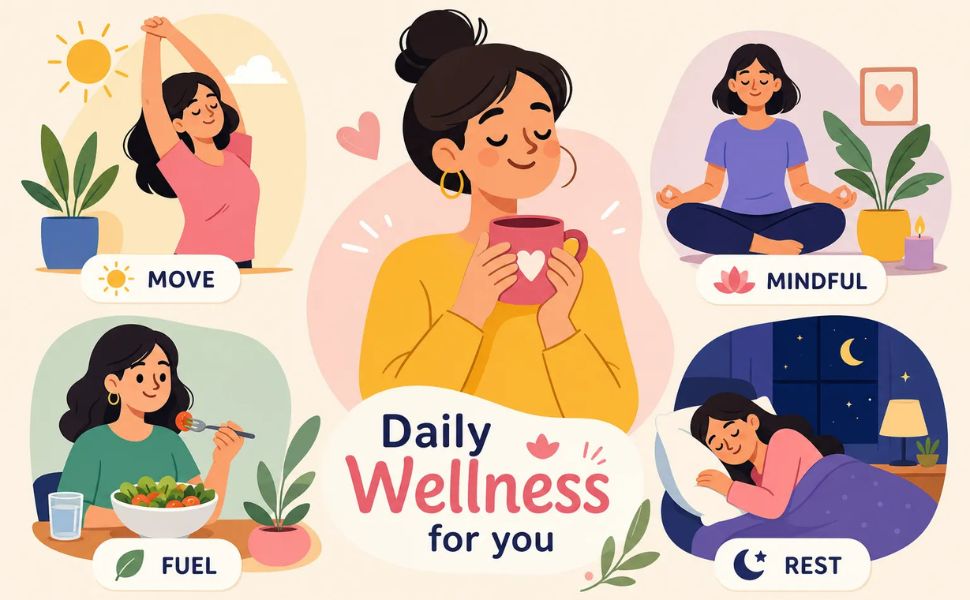
A useful daily wellness routine is a small set of repeatable actions that supports your health without requiring a perfect morning, expensive products or constant motivation. It might include a reliable sleep opportunity, regular meals, fluids within reach, short movement breaks, one meaningful connection and any medicine you have been prescribed. The exact timing can change around work, caring responsibilities, symptoms and energy.
The mistake is trying to install an entire new life on Monday. A 45-minute workout, complicated breakfast, journalling, meditation, skincare, supplements and an hour-long bedtime ritual may all sound healthy individually. Together, they create too many decisions. The routine becomes the project instead of supporting the life you already have.
Begin with one question: what would make ordinary days work slightly better? If the answer is less rushed eating, plan one dependable meal. If it is more movement, choose a repeatable cue for a short walk. If it is better sleep, protect a wind-down and sleep opportunity before buying a sleep product.
Ellasie’s Women’s Wellness Science Library separates broad wellness education, evidence standards and commercial categories. That same separation helps here: build the routine from daily needs first, then consider a product only when it answers a specific question.
Start here: choose one action you can do on four ordinary days this week. Make it easy enough that you do not need a fresh burst of motivation each time.
Why wellness routines fail when life gets busy
Most failed routines are overdesigned. They assume the same wake time, energy, privacy and workload every day. Real life includes late shifts, school runs, poor sleep, periods, caring, travel, illness and deadlines. A plan that works only under ideal conditions is not a routine; it is an occasional best-case day.
The goal is vague
“Feel healthier” is difficult to act on. “Walk for ten minutes after lunch on workdays” is observable. A useful goal describes the behaviour, cue and realistic frequency. You can then see whether the plan happened and whether it helped.
The first step is too large
Starting with the final target creates friction. If you are currently inactive, the first step is not to behave like someone already following a full training plan. It may be putting shoes by the door and walking for five minutes. Progress can expand after the starting behaviour becomes dependable.
The routine relies on clock time alone
“At 7:00 every morning” fails when your schedule changes. A routine-based cue is often more flexible: after brushing your teeth, when the kettle boils, after closing your laptop or before the evening news. The cue should already occur in the setting where the new action is possible.
One missed day becomes proof of failure
Health habits develop through repetition over time, not an unbroken streak. Research on physical-activity habit interventions suggests that action planning, prompts or cues, self-monitoring and problem-solving are commonly used, but effects vary and the evidence does not support one guaranteed formula. A lapse is useful information about the barrier. Adjust the plan and resume at the next suitable cue.
How to build a daily wellness routine in six steps
1. Choose one priority, not five
Pick the area creating the most friction now: sleep, meals, movement, stress, social connection or taking prescribed medicine consistently. Do not assume tiredness, bloating, low mood or poor concentration has one lifestyle cause. If a symptom is persistent, unexplained or worsening, arrange appropriate advice while keeping the routine gentle.
2. Turn the priority into one behaviour
Use a sentence you could see happening:
- “After I make lunch, I will walk for five minutes.”
- “When I finish work, I will fill tomorrow’s water bottle.”
- “After dinner, I will prepare one component of tomorrow’s lunch.”
- “When my wind-down alarm sounds, I will stop work and dim the room.”
Avoid outcome promises such as “boost hormones”, “fix my gut” or “have energy all day”. Those are not behaviours, and they encourage you to judge a routine by a claim it may never have been able to deliver.
3. Define the minimum version
The minimum should feel almost too easy: one minute of stretching, adding fruit to a familiar breakfast, walking to the end of the street, sending one message to a friend or writing tomorrow’s first task on paper. This is not the maximum benefit you will ever get. It is the entry point that protects continuity when capacity is low.
4. Reduce friction before relying on discipline
Put the action where it will happen. Keep comfortable shoes visible. Store a refillable bottle near the bag you take out. Place regular medicines where their instructions allow and where you will safely see them. Keep quick meal ingredients available. Set a single useful reminder rather than several alarms you will learn to ignore.
5. Track the action lightly
A tick on a calendar or a weekly note is enough. Track whether the behaviour happened, not whether you had a “good” or “bad” day. If the goal concerns a symptom, record one relevant measure—such as bedtime, number of wake-ups or afternoon energy—without turning every sensation into a score.
6. Write the recovery plan now
Decide what happens after a late night, missed meal, stressful shift or week away. Your rule might be: “return to the minimum version at the next normal cue.” Do not compensate with double workouts, skipped meals, extra supplements or a punishing reset.
Create minimum, standard and extra versions
A flexible routine has levels. You choose according to available time, health and energy rather than labelling the entire day a failure.
| Area | Minimum day | Standard day | Extra-capacity day |
|---|---|---|---|
| Movement | Stand, stretch or move for two to five minutes | A purposeful walk or short home session | A longer activity or planned strength session |
| Food | Eat an accessible meal or snack rather than waiting for a perfect option | Build a meal from a protein source, carbohydrate and fruit or vegetables | Prepare extra portions or ingredients for another day |
| Fluids | Have a drink with a regular meal or medicine cue | Keep drinks available and check that intake is spread across the day | Prepare a bottle or drinks for travel and tomorrow |
| Mental wellbeing | Pause for a few slow breaths or contact one trusted person | Take a screen-free break, connect or do an enjoyable activity | Protect longer social, creative, outdoor or restorative time |
| Evening | Stop one stimulating task and prepare for bed | Use a repeatable wind-down at a similar time | Prepare food, clothing or the environment for an easier next day |
The minimum version is not a loophole. It is what makes the plan usable through workload changes, symptoms and ordinary unpredictability. When energy returns, move up a level without trying to make up for the previous day.
A flexible morning, daytime and evening wellness framework
Morning: orient rather than optimise
Your morning does not need to start at 5am. Open the curtains or spend time outdoors when practical, take prescribed medicine as directed, and decide what food and movement are realistic. If you eat breakfast, choose something you can repeat; there is no requirement for a complicated “hormone-balancing” meal or detox drink.
Water can be a convenient first drink, but coffee and tea also contribute to fluid intake. The more useful habit is making suitable drinks available through the day. Needs vary with body size, weather, activity, pregnancy, breastfeeding and health conditions, so a viral litre target is not a personal prescription.
Daytime: use ordinary moments
Look for movement already hidden in the day: walking part of a journey, taking stairs when suitable, standing during a call, carrying shopping, active play or a brief walk after lunch. These actions do not replace every part of the weekly activity guidance, but they reduce the all-or-nothing belief that movement counts only in a gym.
Meals do not need to be perfect or identical. Use the broad Eatwell pattern across the day or week: varied fruit and vegetables; starchy carbohydrates, preferably higher-fibre choices; protein sources; dairy or alternatives; and unsaturated fats in small amounts. Batch-cooked, frozen, tinned and convenience foods can all be used thoughtfully. A routine that ignores budget, culture, appetite and available time will not last.
Stress and digestion can influence each other, but this does not mean every digestive symptom is psychological or that one microbiome product will fix mood. Ellasie’s guide to the gut–brain axis in women explains what is established, what remains uncertain and where daily habits fit.
Evening: close the day gently
A useful evening routine creates a transition. Choose two or three actions: close work, lower the lights, put tomorrow’s essentials in one place, write down unfinished tasks, read, listen to something calm or use a brief relaxation exercise. Similar sleep and wake times can help, but shift work, caring and a new baby may make clock-time consistency unrealistic.
Healthy adults often need around seven to nine hours of sleep, with individual variation. If screens make it harder to wind down, reduce or move them earlier. If a strict screen ban creates more stress, begin with notifications off, lower brightness and one screen-free activity. The goal is a repeatable descent into sleep, not passing a bedtime test.
The weekly health foundations that matter more than a perfect morning
| Foundation | Useful UK direction | Busy-life translation |
|---|---|---|
| Movement | Adults should aim for at least 150 minutes of moderate activity or 75 minutes of vigorous activity a week, plus strength work on at least two days, while breaking up long sitting | Accumulate activity across the week; short sessions and practical movement count |
| Food | Use a varied, balanced pattern across the main food groups | Build repeatable meals from accessible components rather than chasing a perfect daily menu |
| Fluids | Six to eight cups or glasses a day is a general guide, not an exact requirement for everyone | Drink regularly, use thirst and pale-yellow urine as practical cues when medically appropriate |
| Sleep | A healthy adult usually needs around seven to nine hours, with personal variation | Protect enough opportunity and a workable wind-down; assess persistent problems |
| Mental wellbeing | Connection, activity, learning, giving and present-moment awareness can support wellbeing | Choose one form that feels supportive rather than adding five more daily tasks |
These are population-level directions, not moral scores and not suitable targets for every medical situation. If activity causes unusual symptoms, if you are returning after a long break, or if a clinician has given you different advice, use the safer individual plan.
Adapt the routine to your life stage, health and workload
Periods and cyclical symptoms
You do not need a completely different wellness routine for every menstrual phase. Use symptoms and capacity as the guide. On days with pain, heavy bleeding, migraine or marked fatigue, the minimum version may be appropriate. Severe, worsening or disruptive symptoms deserve assessment rather than a more elaborate cycle-synced programme.
Pregnancy and after having a baby
Pregnancy changes nutrition, supplement and activity decisions. UK guidance includes folic acid when trying to conceive and during early pregnancy, plus vitamin D advice; some people need a prescribed higher folic-acid dose. Avoid treating a general wellness checklist as antenatal care. Follow your midwife’s or GP’s guidance and check every supplement, including multivitamins and botanicals.
After birth, sleep and recovery may be fragmented. A realistic routine may centre on food within reach, fluids, prescribed medicine, support and gradual activity appropriate to your recovery. “Bounce back” programmes are not a health requirement.
Perimenopause and menopause
Menopause does not automatically create a supplement requirement or make every change hormonal. Review sleep, alcohol, meals, activity, medicines and symptoms, then seek appropriate treatment when needed. Ellasie’s decision guide explains whether menopause supplements are necessary, while the guide to fatigue and weight changes during menopause separates practical support from causes that need assessment.
Shift work, chronic illness and disability
Anchor actions to your own waking, working and sleeping sequence rather than someone else’s morning. Activity can include adapted or seated movement, and strength can come from many daily tasks. If you have a condition that affects exertion, fluids, diet or sleep, use advice specific to that condition. A generic weekly target should not override a clinical management or pacing plan.
How to decide whether a supplement belongs in your routine
A supplement needs a reason; a busy schedule is not a deficiency. Convenience may make a suitable product easier to use, but it does not prove that the product is needed or effective.
- Name the purpose. Are you following national guidance, covering a restricted diet, correcting a confirmed deficiency or acting on professional advice?
- Check whether food, treatment or another action addresses the real issue. A supplement should not be used to self-diagnose persistent fatigue, insomnia, low mood, pain or digestive symptoms.
- Read the complete daily serving. Check amounts, units, plant parts, strains, allergens, warnings and every added ingredient.
- Add up duplicates. A multivitamin, gummy, powder, fortified food and single nutrient can contain the same ingredient.
- Check medicines and health conditions. Ask a pharmacist or clinician when you are pregnant, breastfeeding, taking regular medicine, living with a medical condition or preparing for surgery.
- Set a review point and stop rule. Know what would show that it is useful, unnecessary or causing a problem.
Vitamin D is the clearest general UK example: adults should consider 10 micrograms daily during autumn and winter, while some higher-risk groups should consider it throughout the year. That does not justify automatically adding iron, magnesium, probiotics, ashwagandha or a “women’s balance” blend.
Ellasie’s page on how Ellasie chooses ingredients explains why ingredient evidence, finished-product evidence, formulation route and authorised claims are separate checks. A longer label and a more impressive morning stack are not better by default.
Supplement safety: Follow the label and do not exceed the recommended amount. If you feel unwell after starting a supplement, stop it and contact a healthcare professional; do not change the dose or add another product to counter the reaction.
Review the routine, troubleshoot it and restart without drama
Review the design after two to four weeks, but do not expect every action to feel automatic by then. Ask:
- Did the behaviour happen often enough to assess?
- Was the cue obvious and available?
- Was the minimum version genuinely manageable?
- Which barrier appeared most often: time, energy, environment, cost, symptoms or forgetting?
- Did the action support the original goal, or did it become another obligation?
Change one part at a time. Move the cue, reduce the action, prepare the environment or choose a more enjoyable version. If an evening workout consistently does not happen, a lunchtime walk may fit better. If meal preparation fails on Sundays, keep dependable frozen or tinned options rather than repeating the same unrealistic plan.
Do not use a missed week as a reason to buy a new system. Restart with the smallest version. If you repeatedly cannot do even that, the goal may be poorly timed, the action may not matter enough, or your physical or mental health may need attention before habit optimisation.
When a wellness routine is not enough
A routine can support health, but it cannot identify the cause of a symptom. See a GP if you have felt tired for a few weeks without knowing why, tiredness affects daily life, or it occurs with symptoms such as weight loss, mood changes or gasping or choking noises during sleep. Persistent sleep problems, significant digestive changes, severe period symptoms or menopause symptoms affecting daily life also deserve proper assessment.
Speak with a pharmacist or clinician before changing supplements when pregnancy, breastfeeding, regular medicines or a health condition is relevant. Do not stop prescribed medicine because a wellness product promises a more natural solution.
Seek urgent help when symptoms are severe or rapidly worsening, or if you feel unable to cope or keep yourself safe. A checklist should never delay medical or mental-health support.
Bottom line
A simple daily wellness routine for busy women is not a product list or a perfect morning. It is a repeatable structure built around the smallest useful actions: enough opportunity for sleep, accessible food and fluids, movement across the week, moments of connection or recovery and appropriate medical care.
Choose one priority. Define the behaviour. Attach it to a reliable cue. Create a minimum version and a recovery rule. Add another action only when the first no longer requires constant negotiation.
Supplements may have a place when there is a clear reason, suitable evidence and a safe product-specific decision. They should not compensate for an impossible routine, diagnose symptoms or turn daily wellbeing into an expensive stack.
Frequently asked questions
What should be in a daily wellness routine for a busy woman?
Start with one repeatable action supporting sleep, meals, fluids, movement or mental wellbeing. Prescribed medicine should be taken as directed. You do not need to perform every healthy behaviour each morning or add supplements without a clear reason.
How long should a daily wellness routine take?
There is no ideal duration. A minimum routine may take two to five minutes, while movement, meal preparation and social time can happen across the day or week. The right length is the one that fits ordinary days and still supports the chosen goal.
Do I need a morning routine to be healthy?
No. Shift workers, carers, parents and people with variable schedules may not have a conventional morning. Anchor habits to your own waking, meal, work and sleep sequence. Weekly consistency matters more than copying someone else’s clock.
How long does it take for a wellness habit to stick?
There is no universal number of days. Habit development varies with the behaviour, cue, context and person. Repeat a small action in a stable context, track it lightly and solve the barriers that recur rather than expecting a guaranteed 21-day transformation.
Which supplements should be part of a daily routine?
No universal stack is suitable for every woman. UK adults should consider vitamin D during autumn and winter, with year-round advice for some higher-risk groups. Other supplements should follow a dietary gap, confirmed deficiency, specific national advice or an appropriate professional recommendation.
What should I do if I miss several days?
Return to the minimum version at the next practical cue. Do not double the activity, skip meals or take extra supplements. Identify the barrier, reduce friction and change the plan if the same problem keeps returning.
References and further reading
- Ma H, Wang A, Pei R, Piao M. Effects of habit formation interventions on physical activity habit strength: meta-analysis and meta-regression. International Journal of Behavioral Nutrition and Physical Activity. 2023;20:109.
- NHS: Physical activity guidelines for adults aged 19 to 64. Weekly aerobic and strength targets, breaking up sitting and adapting activity to health and pregnancy.
- NHS: The Eatwell Guide. Balanced eating pattern, food groups and general fluid guidance.
- NHS Every Mind Matters: Sleep problems. Adult sleep needs, sleep-habit guidance and when to seek support.
- NHS Every Mind Matters: How to fall asleep faster and sleep better. Regular routines, wind-down ideas, activity and managing worries.
- NHS: Five steps to mental wellbeing. Connection, activity, learning, giving and present-moment awareness.
- NHS: Vitamin D. UK autumn-and-winter advice, higher-risk groups and safe-use information.
- Food Standards Agency: Food supplements guidance. Label directions, dose, pregnancy, breastfeeding, medicines and adverse effects. Published 25 June 2026.
- NHS: Tiredness and fatigue. Possible causes, self-care boundaries and when to see a GP.
- NHS: Pregnancy vitamins and supplements. Folic acid, vitamin D, iron and supplements to avoid. Page reviewed June 2026.