



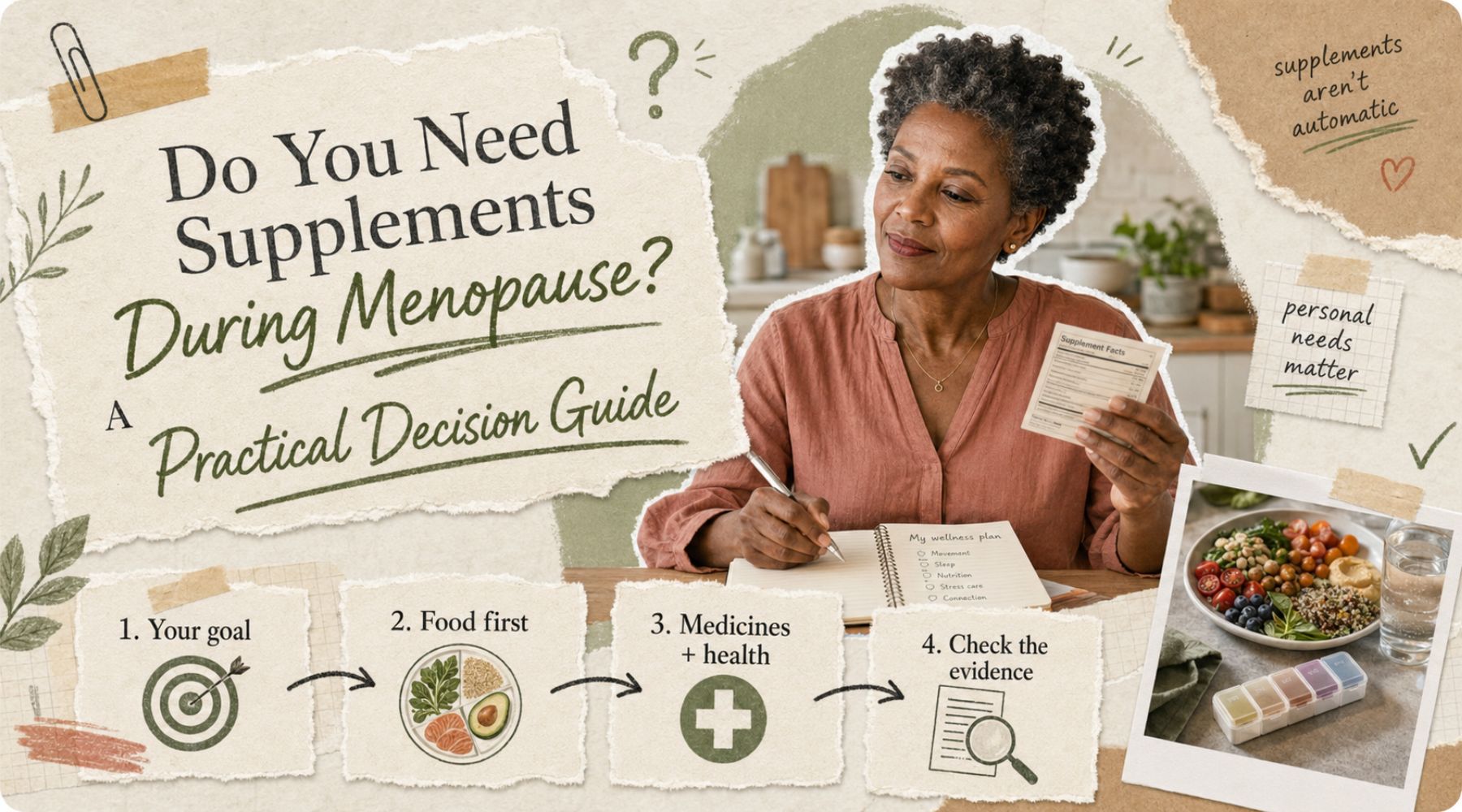
Medical note: Menopause symptoms do not prove that you have a vitamin or mineral deficiency. Food supplements are not medicines and should not be used to treat hot flushes, low mood, vaginal symptoms, unexplained fatigue or another medical problem. Ask a GP, pharmacist or registered dietitian for individual advice if symptoms are persistent, severe, new or affecting daily life, or if you take medicines or have an existing condition.
Key takeaways
- Menopause does not automatically mean you need a menopause supplement. The useful question is whether you have a dietary gap, a higher-risk situation, a confirmed deficiency or a specific recommendation that applies to you.
- Vitamin D is the clearest general UK example. Adults should consider 10 micrograms daily during autumn and winter, while some higher-risk groups should consider it throughout the year.
- Menopause symptoms and nutrient deficiency symptoms can overlap. Fatigue, poor concentration, sleep disruption or low mood should not be self-diagnosed from a supplement advert.
- More ingredients do not make a formula more necessary. Check the daily amounts, duplicated nutrients, botanical interactions and evidence for the finished product.
- Supplements do not replace established menopause care. A product cannot substitute for HRT, menopause-specific CBT, vaginal oestrogen, moisturisers, lubricants or another appropriate treatment.
Do you need supplements during menopause? The direct answer
No—not simply because you are in perimenopause or menopause. There is no universal menopause multivitamin, botanical blend or probiotic that every woman needs. Many people can meet most nutritional requirements through food, alongside the general vitamin D advice that applies to UK adults.
A targeted supplement can still be useful. It may help when your diet does not reliably provide a nutrient, when a health condition or medicine changes absorption or requirements, when a test confirms deficiency, or when a clinician recommends it as part of osteoporosis or other care. Convenience can also matter: a supplement may be an easier way to cover a genuine gap. Convenience, however, is not evidence that the gap exists.
That distinction protects you from two bad extremes. One is assuming all supplements are pointless. The other is treating a long ingredient list as a solution to every menopause symptom. For the wider picture—including stages, symptoms, HRT, CBT and local treatment for vaginal symptoms—use Ellasie’s menopause symptoms and treatment guide.
A practical rule: start with the reason for taking something, not the product. If you cannot state the gap, risk factor, recommendation or measurable goal, you are not yet ready to choose the supplement.
Three questions people often mix together
1. Am I meeting my normal nutritional needs?
This is mainly a diet and life-stage question. Calcium, vitamin D, protein, fibre, iron, vitamin B12 and other nutrients all have ordinary roles in health. Menopause may make bone, muscle and cardiovascular health feel more urgent, but it does not convert every normal nutrient into a menopause treatment.
2. Do I have a deficiency or higher risk of one?
This depends on factors such as diet, sunlight exposure, heavy bleeding, digestive disease, previous stomach or bowel surgery, medicines, age and medical history. Some situations justify a dietary review, a test or professional supplementation. Others can be addressed with food.
3. Am I trying to treat a menopause symptom?
This is a treatment question, not automatically a nutrition question. The Food Standards Agency states that food supplements are not medicinal products and should not be sold as preventing, treating or curing medical conditions or symptoms, including menopause symptoms. The NHS lists HRT and non-hormonal clinical options for bothersome symptoms and warns that evidence and safety for many herbal menopause remedies are limited.
A nutrient can have an established role in normal physiology without the finished product treating hot flushes, insomnia, anxiety, weight gain or vaginal dryness. Those are different levels of evidence.
A five-step decision framework
- Define the purpose. Are you following national vitamin D advice, correcting a confirmed deficiency, covering a restricted diet, addressing a clinician-identified bone-health need or hoping to improve a symptom? Write down one primary reason.
- Check food and current guidance first. Estimate how often you eat calcium-rich foods, protein sources, oily fish, fortified foods, fruit, vegetables, wholegrains and pulses. Look at UK advice rather than a brand’s ideal customer profile.
- Identify personal risk factors. Consider limited sun exposure, a vegan or highly restricted diet, heavy periods during perimenopause, digestive disease, bariatric surgery, osteoporosis risk and medicines that affect nutrients or interact with supplements.
- Decide whether testing would change the plan. A full nutrient panel is not automatically required before every basic supplement. Testing is useful when symptoms, history or treatment decisions suggest a specific deficiency or condition and the result would change what happens next.
- Audit the exact label. Check the daily serving, amounts, units, warnings, allergens, duplicated ingredients and botanical interactions. Decide how long you will use it and what would make you stop.
| Your situation | Best first check | Possible supplement role | What not to assume |
|---|---|---|---|
| General UK adult in autumn or winter | Current vitamin D guidance and total intake | 10 micrograms of vitamin D daily is the standard consideration | That menopause creates a separate high-dose requirement |
| Low calcium intake | Food sources, portions and osteoporosis care | May fill a genuine shortfall after dietary review | That every postmenopausal woman needs calcium tablets |
| Vegan or very restricted diet | Fortified foods and dietitian-led nutrient review | B12, iodine or other targeted support may be appropriate | That one generic menopause blend covers every restriction |
| Heavy perimenopausal periods and fatigue | GP assessment and blood testing for possible anaemia | Iron when deficiency is found and the cause is addressed | That fatigue proves iron deficiency |
| Hot flushes, sleep or mood symptoms | Menopause assessment and evidence-based treatment options | A supplement only for a separate nutritional need | That a nutrient claim proves symptom treatment |
| Multiple supplements already used | Total daily amounts across every label | Simplifying the routine may be safer than adding another product | That each product is safe because its own dose looks moderate |
When a supplement may be reasonable
A supplement decision becomes stronger when at least one of these applies:
- a national recommendation applies, such as the UK’s seasonal vitamin D advice;
- your diet consistently excludes an important source and fortified alternatives are insufficient;
- a blood test confirms deficiency and a clinician recommends replacement;
- a diagnosed condition, surgery or medicine affects absorption or requirements;
- a clinician recommends calcium, vitamin D or another nutrient alongside treatment;
- a registered dietitian identifies a practical gap that food changes alone are unlikely to close.
The case is weaker when the reason is a vague promise such as “balance hormones”, “detox menopause”, “reset metabolism” or “replace what oestrogen takes away”. Menopause is not a single nutrient-deficiency state, and a product name cannot establish individual need.
It is also reasonable to decide that you do not need a supplement. Improving breakfast protein, choosing calcium-fortified foods, eating more varied plants, reducing alcohol, moving regularly and using appropriate medical treatment may do more for the actual problem.
Vitamin D, calcium and bone health
Bone loss accelerates for a period after menopause as oestrogen falls, but the NHS does not set a separate calcium or vitamin D dose simply for being menopausal. Bone health depends on the whole picture: adequate nutrition, weight-bearing and muscle-strengthening activity, smoking and alcohol, body weight, falls risk, family history, medicines, previous fractures and any osteoporosis treatment.
Vitamin D
UK adults should consider a daily supplement containing 10 micrograms of vitamin D during autumn and winter. People with little sun exposure, people who cover most of their skin outdoors and people with dark skin may need to consider 10 micrograms throughout the year. This guidance applies across adulthood; it is not a special menopause dose.
Check the total if vitamin D appears in a menopause blend, multivitamin, calcium product and separate tablet. The NHS advises that 10 micrograms is enough for most people and that adults should not take more than 100 micrograms daily unless following medical advice.
Calcium
Adults need around 700 mg of calcium a day, and many can obtain it from dairy foods or fortified alternatives, calcium-set tofu, bread, pulses, nuts, green vegetables and fish eaten with the bones. A calcium supplement may make sense when intake is genuinely low or a clinician recommends it, but it is not an automatic prescription for every woman over 45.
Do not overlook vitamin A on combined labels
More is not always better for bones. NHS guidance advises postmenopausal women and others at risk of osteoporosis to avoid exceeding an average of 1.5 mg of vitamin A as retinol per day from food and supplements. Check multivitamins and fish-liver-oil products rather than focusing only on calcium and vitamin D.
Diet restrictions, vitamin B12 and iron
Plant-based diets
A well-planned plant-based diet can support health, but vitamin B12 is not naturally present in fruit, vegetables or grains. Vegan diets therefore need reliable fortified foods or supplementation. Risk can also rise with pernicious anaemia, some digestive conditions, stomach surgery, metformin or proton-pump inhibitors. This is not caused by menopause, even if the timing overlaps.
Calcium, iodine, iron, protein and omega-3 may also deserve attention depending on what the diet includes. A registered dietitian can identify the smallest useful change instead of defaulting to a high-dose all-in-one product.
Iron during perimenopause and after menopause
Heavy periods are a common cause of iron-deficiency anaemia during perimenopause. Fatigue, shortness of breath, palpitations, headaches, hair loss or restless legs can occur with anaemia, but those symptoms have other causes too. The NHS recommends assessment and a blood test rather than guessing.
After periods stop, routine iron is not automatically beneficial. New iron deficiency needs its cause investigated, particularly when menstrual blood loss no longer explains it. Do not use an iron-containing menopause formula as a diagnostic trial; iron can cause side effects and overdose is dangerous to children.
Menopause symptoms are not a supplement shopping list
Hot flushes do not tell you that you need black cohosh. Tiredness does not tell you that you need iron, B12 or magnesium. Brain fog does not diagnose a B-vitamin deficiency. Vaginal dryness does not prove that an oral moisture blend or probiotic is required.
Symptoms should be assessed according to their pattern and impact. The NHS lists HRT and several non-hormonal clinical options for menopause symptoms. Local vaginal oestrogen, moisturisers and lubricants have different roles for genitourinary symptoms. Supplements can sit alongside appropriate care when there is a separate nutritional reason, but they should not delay it.
Authorised nutrition claims can also be misunderstood. For example, vitamin B6 may be described using permitted claims about normal hormonal activity, psychological function or tiredness and fatigue when the product meets the conditions. That does not prove that the finished formula treats a hormone disorder, depression or menopause fatigue. The NHS advises not taking more than 10 mg of vitamin B6 daily in supplements unless a doctor recommends it.
Botanicals and menopause blends: use a higher safety bar
Menopause products may contain black cohosh, red clover or isoflavones, sage, St John’s wort, ashwagandha, chasteberry or several botanicals in one blend. “Natural” does not mean medicine-free, interaction-free or appropriate for long-term use.
The NHS says there is very little evidence showing how well herbal remedies such as red clover and black cohosh work for menopause symptoms or how safe they are. The British Menopause Society similarly concludes that few complementary options have proven effectiveness. Different extracts, doses and combinations also prevent evidence for one preparation being transferred automatically to another.
Always ask a pharmacist before combining a herbal product with prescribed medicine. This is especially important with HRT, antidepressants, blood thinners, diabetes or blood-pressure medicines, thyroid treatment, epilepsy medicines and cancer treatment. The NHS specifically warns that St John’s wort can reduce how well some oral HRT products work.
A Traditional Herbal Registration mark can show that a qualifying herbal medicine meets registration and manufacturing requirements; it does not prove that an ordinary food supplement or multi-ingredient blend treats menopause symptoms. Avoid unlicensed herbal medicines from unknown online sellers.
Where probiotics fit
Menopause does not create a standard probiotic requirement. Probiotic evidence is organism-, strain-, dose-, route- and outcome-specific. A CFU number alone cannot show that a product is necessary, and a product studied for digestive symptoms cannot automatically be presented as support for vaginal dryness or genitourinary syndrome of menopause.
If you are considering one for a separate digestive or microbiome goal, use Ellasie’s probiotic dose and CFU guidance. People with a weakened immune system, serious illness or complex medical history should ask a clinician before use.
How to compare a menopause supplement label safely
- Read the daily serving, not the front of the pack. “One capsule” and “one serving” may be different.
- Record each active amount and unit. Milligrams, micrograms, IU and CFU are not interchangeable.
- Add duplicated nutrients across products. Include multivitamins, gummies, fortified powders, fish oils and prescribed calcium or vitamin D.
- Look for undisclosed blends. A total blend weight does not reveal the amount of each botanical or show that any ingredient matches a studied preparation.
- Separate ingredient evidence from finished-product evidence. Research on one nutrient, branded extract or combination does not prove the retail product produces the same outcome.
- Check warnings and medicine compatibility. Pregnancy can still occur during perimenopause, and HRT is not contraception.
- Choose a reputable seller and traceable product. Check expiry, contact details, instructions and whether claims are authorised rather than relying on testimonials.
- Set a review point. Know why you are taking it, how long you intend to use it and what side effect or lack of need would make you stop.
Ellasie’s page on how Ellasie chooses ingredients explains why formula route, ingredient disclosure, evidence, authorised claims and finished-product documentation must be assessed separately.
Stop and seek advice if you feel unwell after starting a supplement. Do not raise the dose or add another product to “balance” the reaction. Keep the packaging and ingredient list so a pharmacist or clinician can assess the exact product.
Do you need blood tests or professional advice?
Not every supplement decision needs a blood test. Seasonal vitamin D guidance is population advice, and simple dietary changes may be obvious without testing. Tests become more useful when symptoms or history raise a specific question—such as possible anaemia, B12 deficiency, thyroid disease, coeliac disease or another condition—or when the result would change treatment.
The right professional depends on the decision:
- GP or menopause clinician: symptoms, possible deficiency, heavy bleeding, osteoporosis risk, early menopause, HRT and medical diagnosis;
- pharmacist: medicine–supplement interactions, dose duplication and choosing an appropriate over-the-counter product;
- registered dietitian: restricted diets, food-first nutrient assessment, digestive conditions and a practical long-term plan;
- specialist team: supplements alongside cancer treatment, severe liver or kidney disease, bariatric surgery or complex medicines.
Take photographs or a written list of every medicine, vitamin, mineral, botanical, probiotic and powder you use. “A menopause supplement” is not enough information for an interaction check.
When to get medical help instead of adding a supplement
Book an appointment when symptoms affect sleep, work, relationships or quality of life; when fatigue is persistent or worsening; when periods become very heavy; or when you want to discuss HRT or non-hormonal treatment. Symptoms before 45, and especially before 40, also need proper assessment.
Any vaginal bleeding after 12 months without a period should be checked by a GP, even if it happens once or appears only as spotting. Seek prompt advice for unexplained weight loss, marked shortness of breath, chest pain, fainting, new neurological symptoms, severe abdominal or pelvic pain, jaundice, or signs of a serious allergic reaction.
Do not stop prescribed medicine, HRT or cancer treatment because a supplement advert suggests a more “natural” route. Ask the clinician or pharmacist managing your care before making changes.
Bottom line
You do not need a supplement merely because menopause has started. You may need one because a national recommendation applies, your diet leaves a meaningful gap, a condition or medicine changes your needs, a test confirms deficiency or a clinician has recommended targeted support.
Start with the purpose, then check food, risk factors, evidence, medicines and the full daily dose. Keep symptom treatment separate from nutritional support. If the reason survives those checks, choose the simplest product that covers the genuine need rather than the formula with the longest promise.
Frequently asked questions
Should every woman take a menopause supplement?
No. Menopause does not create one universal supplement requirement. A targeted product may be appropriate for a dietary gap, higher-risk situation, confirmed deficiency or professional recommendation. UK seasonal vitamin D advice applies generally to adults rather than only to menopausal women.
What is the best supplement to take during menopause?
There is no single best option because the right decision depends on the purpose. Vitamin D may follow national guidance; calcium may address low intake; B12 may be needed with a vegan diet or absorption problem; iron should follow assessment when deficiency is suspected. A supplement should not be selected as a universal treatment for symptoms.
Is a menopause multivitamin worth taking?
It may be convenient when its daily amounts match genuine needs and do not duplicate other products. It is poor value when it adds unnecessary nutrients, undisclosed blends or high doses without a clear reason. Compare the complete label with your diet and current routine.
Do I need calcium supplements after menopause?
Not automatically. Adults need calcium, but many can meet requirements through food. A supplement may be appropriate when intake is low or a clinician recommends it for osteoporosis care. Review vitamin D, exercise and broader fracture risk rather than treating calcium tablets as the whole plan.
Can I take menopause supplements with HRT?
Do not assume the combination is safe. Vitamins, minerals and herbs can interact with medicines, and St John’s wort may reduce the effect of some oral HRT. Show the exact ingredient list and daily amounts to a pharmacist or clinician before combining products.
Do I need blood tests before taking supplements?
Not for every basic decision. Tests are useful when symptoms, diet, medical history or treatment raise a specific concern and the result would change the plan. Possible iron or B12 deficiency, thyroid disease, malabsorption and unexplained persistent symptoms deserve assessment rather than a broad self-ordered panel.
References and further reading
- Food Standards Agency: Food supplements guidance. Definition, balanced-diet role, menopause-claim boundary, label checks and consumer safety. Published 25 June 2026.
- NHS: Treatment for menopause and perimenopause. HRT, non-hormonal treatments and limitations of herbal remedies. Page last reviewed 19 May 2026.
- NHS: Food for healthy bones. Calcium, vitamin D, menopause, vegan sources and retinol caution.
- NHS: Vitamin D. UK seasonal and year-round advice, amounts and upper limit.
- British Dietetic Association: Eating well for the perimenopause and menopause. Diet, bone health, plant oestrogens and supplement advice.
- NHS: Causes of vitamin B12 or folate deficiency anaemia. Diet, absorption, medicines and risk factors.
- NHS: Iron deficiency anaemia. Symptoms, testing, causes and clinician-led treatment.
- NHS: B vitamins and folic acid. Vitamin B6 and B12 sources, requirements and supplement cautions.
- NHS: Vitamin A. Retinol intake and postmenopausal bone-health caution.
- NHS: Herbal medicines and complementary therapies. Suitability, medicine interactions and product-safety checks. Page last reviewed 1 May 2026.
- NHS: Taking continuous combined HRT with medicines and herbal supplements. St John’s wort and interaction advice.
- British Menopause Society: Non-hormonal-based treatments for menopausal symptoms. Evidence limitations for complementary and alternative options. Reviewed November 2025.
- NHS: Probiotics. Product variability, evidence limitations and advice for people with an existing condition or weakened immunity.
- NHS: Early or premature menopause. Age definitions, assessment and treatment context.
- NHS: Postmenopausal bleeding. Why any bleeding after menopause needs GP assessment.